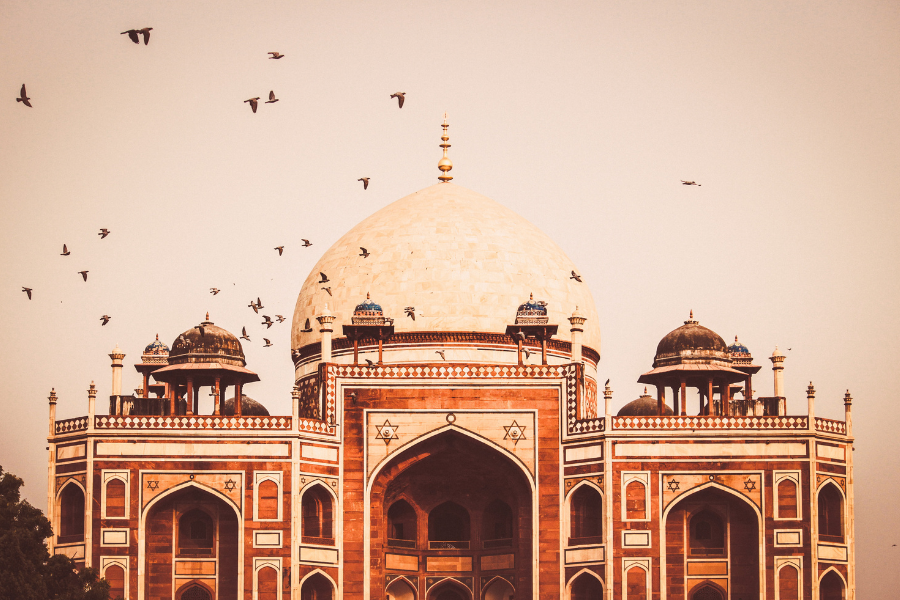
Delhi is more than a political capital—it is a living historical landscape shaped by ancient settlements, powerful dynasties, medieval sultanates, the Mughal Empire, British colonial rule, the freedom movement, Partition, and the making of modern India. Few cities in South Asia have witnessed such a continuous succession of civilizations and political powers. Introduction Situated along the Yamuna River in northern India, Delhi occupies a strategically important position between the Indo-Gangetic plains and the routes leading toward northwestern India. Its geography helped make it a center of trade, military power, administration, and culture. The name Delhi is associated with several historical names and settlements, including Dhillika, Dilli, Dehli, and Shahjahanabad. Rather than being a single city that simply grew over time, historical Delhi developed through a series of settlements established by different rulers. This is why Delhi is often described as a city of cities.
1. Delhi in Ancient India The history of the Delhi region reaches back thousands of years. The area around present-day Delhi was inhabited during ancient periods, and archaeological discoveries demonstrate the presence of early settlements in and around the region. Delhi's location beside the Yamuna made it attractive for agriculture and settlement. Indraprastha and the Mahabharata Delhi is traditionally associated with Indraprastha, the city described in the Mahabharata as the capital of the Pandavas. According to the epic tradition, Indraprastha stood near the Yamuna. Modern historians distinguish between literary tradition and archaeological evidence, so it is difficult to establish that the ancient Indraprastha was exactly the same settlement as later Delhi. Nevertheless, the association has played an important role in Delhi's cultural identity. The area around Purana Qila (Old Fort) is traditionally connected with Indraprastha. Archaeological excavations at the site have produced evidence of occupation dating back to ancient periods.
2. The Tomar and Chauhan Period One of the important early medieval phases of Delhi's history began with the Tomar dynasty. The Tomars are traditionally credited with establishing or developing a settlement known as Dhillika around the 8th–11th centuries. The exact chronology and nature of the earliest settlement remain subjects of historical discussion. The Tomar ruler Anangpal II is particularly associated with the development of Delhi. One of the most famous monuments connected with this period is the Iron Pillar, now located within the Qutb complex. The pillar itself is considerably older than the medieval Delhi monuments surrounding it and probably dates to the Gupta period. Later, Delhi came under the control of the Chauhans (Chahamanas). The famous ruler Prithviraj Chauhan became associated with Delhi and Ajmer. His defeat by Muhammad Ghori in the late 12th century changed the political history of northern India.
3. The Beginning of the Delhi Sultanate The defeat of Prithviraj Chauhan in 1192 was a major turning point. Following the expansion of Ghurid power, Qutb-ud-din Aibak established himself as an important ruler in northern India. After Muhammad Ghori's death, Aibak became the founder of what historians generally call the Mamluk or Slave dynasty, the first ruling dynasty of the Delhi Sultanate. Delhi gradually became one of the principal centers of Islamic political power in northern India. Qutb Minar The Qutb Minar became the most recognizable monument of this early Sultanate period. Construction was begun by Qutb-ud-din Aibak and continued by his successors. The complex contains buildings representing several stages of Delhi's medieval history. The Qutb complex is significant not only architecturally but also historically because it demonstrates the interaction of different artistic and architectural traditions.
4. The Five Dynasties of the Delhi Sultanate The Delhi Sultanate lasted for roughly three centuries, from the early 13th century until the establishment of Mughal rule in 1526. It consisted principally of five dynasties: Mamluk/Slave dynasty Khalji dynasty Tughlaq dynasty Sayyid dynasty Lodi dynasty Each contributed to Delhi's political and architectural development. The Khaljis The Khalji dynasty rose to power in the late 13th century. One of its most famous rulers was Alauddin Khalji, who expanded the Sultanate significantly. Alauddin Khalji strengthened Delhi's military defenses and constructed Siri, one of the historical cities associated with Delhi. His reign also saw major architectural projects, including work in the Qutb complex.
5. Muhammad bin Tughlaq and the Moving Capital The Tughlaq dynasty produced one of medieval India's most controversial rulers: Muhammad bin Tughlaq. He is particularly famous for his decision to shift the capital from Delhi to Daulatabad in the Deccan. The move was extraordinarily ambitious. Large numbers of people were ordered to relocate, but the policy eventually proved impractical, and the capital was returned to Delhi. Muhammad bin Tughlaq also developed Tughlaqabad, a massive fortified city associated with his predecessor Ghiyasuddin Tughlaq. Today, the ruins of Tughlaqabad provide an impressive view of medieval Delhi's military architecture.
6. Timur's Invasion In 1398, the Central Asian conqueror Timur invaded Delhi. His forces defeated the Delhi Sultanate and captured the city. The invasion resulted in enormous destruction and loss of life. The weakened Sultanate struggled to recover, and Delhi entered a period of political instability. This instability eventually contributed to the rise of new regional powers and the eventual establishment of the Lodi dynasty.
7. The Lodi Dynasty The Lodi dynasty was the final dynasty of the Delhi Sultanate. The Lodis were of Afghan origin and ruled during the 15th and early 16th centuries. Several monuments associated with the Lodi period survive in today's Delhi, particularly around Lodi Gardens. The tombs and gardens of the period are important examples of the architectural traditions that developed before the Mughals. The Lodi dynasty ended after Babur defeated Ibrahim Lodi at the First Battle of Panipat in 1526. This marked the beginning of Mughal rule in northern India.
8. The Mughal Era The Mughal period transformed Delhi dramatically. Babur established Mughal power after the First Battle of Panipat. His successors expanded the empire, but Delhi's importance varied under different Mughal rulers. Humayun and later Akbar were associated with other major imperial centers, particularly Agra and Fatehpur Sikri. Delhi's greatest Mughal transformation came under Shah Jahan.
9. Shah Jahanabad: The Mughal City In the 17th century, Emperor Shah Jahan decided to establish a new imperial city in Delhi. Construction began around 1639, and the city became known as Shahjahanabad. Modern Old Delhi largely occupies the area of this historic city. Shahjahanabad included: The Red Fort Jama Masjid Chandni Chowk Major markets Residential neighborhoods Gardens Mosques Palaces Caravanserais The city became a major center of Mughal culture, commerce, literature, and political power. 10. The Red Fort The Red Fort became the heart of Shah Jahan's imperial city. Built primarily from red sandstone, it contained palaces, audience halls, gardens, mosques, and administrative spaces. The famous Diwan-i-Am was used for public audiences, while the Diwan-i-Khas was associated with more private imperial meetings. The fort became one of the enduring symbols of Delhi. Centuries later, it acquired another meaning: after Indian independence, the Prime Minister began delivering the annual Independence Day address from the Red Fort.
11. Chandni Chowk Chandni Chowk was one of the principal commercial centers of Shahjahanabad. It was designed as an important market and urban thoroughfare leading toward the Red Fort. Over time, Chandni Chowk became famous for its shops, food, religious buildings, traders, craftsmen, and densely populated streets. Even today, the area offers a remarkable connection to the urban character of Old Delhi.
12. Delhi and the Decline of Mughal Power After Aurangzeb's death in 1707, Mughal political authority weakened considerably. Delhi remained an important imperial city, but the Mughal emperor's actual political power declined. The city experienced invasions and political upheaval. In 1739, Persian ruler Nader Shah invaded Delhi following his victory over the Mughal forces at the Battle of Karnal. His invasion was followed by enormous destruction and the removal of immense wealth from Delhi. Later, Ahmad Shah Abdali and various regional powers also influenced northern India's political landscape.
13. Delhi under the British The British East India Company gradually expanded its control over India. In 1803, British forces captured Delhi. The Mughal emperor continued to reside in Delhi, but his authority was largely symbolic. The British controlled the political and military realities of the region. Delhi therefore became a fascinating political contradiction: the Mughal emperor remained an important cultural symbol while the British exercised effective power.
14. The Revolt of 1857 One of the most important events in Delhi's history occurred in 1857. Indian soldiers, known as sepoys, rebelled against the East India Company's rule. The rebellion spread rapidly across northern India. Delhi became the symbolic center of the uprising because of the presence of the Mughal emperor Bahadur Shah II (Bahadur Shah Zafar). The rebels declared him their symbolic leader. British forces eventually recaptured Delhi after a prolonged military campaign. The consequences were enormous. The East India Company was abolished, and governance of India was transferred directly to the British Crown. Bahadur Shah Zafar was arrested and eventually exiled to Rangoon, where he died in 1862. The Mughal political era had effectively ended.
15. Delhi Becomes the Capital of British India For much of British rule, Calcutta (Kolkata) was the capital of British India. That changed in 1911. At the Delhi Durbar, King George V announced that the capital would be transferred from Calcutta to Delhi. The decision reflected Delhi's historical and strategic importance. The British planned an entirely new administrative city south of Shahjahanabad. This became New Delhi.
16. The Creation of New Delhi British architects Edwin Lutyens and Herbert Baker played major roles in designing New Delhi. Construction took place primarily during the 1910s and 1920s. The new city was characterized by: Broad avenues Large government buildings Formal gardens Monumental architecture Carefully planned residential areas Important buildings included: Viceroy's House, now Rashtrapati Bhavan Secretariat buildings Parliament House India Gate New Delhi was formally inaugurated as the capital in 1931.
17. Delhi and India's Freedom Movement Delhi played an important role in India's struggle for independence. Political meetings, protests, nationalist activities, newspapers, and organizations all contributed to the city's political atmosphere. The Indian National Congress, revolutionary organizations, student groups, workers, and other political movements operated in and around Delhi during the independence struggle. Mahatma Gandhi also spent considerable time in Delhi during the final years of British rule. His last major period in Delhi occurred during the turbulent months surrounding independence and Partition.
18. Independence and Partition, 1947 The year 1947 transformed Delhi once again. India became independent on 15 August 1947. Jawaharlal Nehru delivered his famous independence speech from the Red Fort. But independence was accompanied by the Partition of British India. Millions of people crossed the newly created borders between India and Pakistan. Delhi experienced a massive influx of refugees, particularly from areas that became part of Pakistan. Refugee camps appeared throughout the city, while abandoned properties were occupied or redistributed. The demographic, cultural, economic, and social character of Delhi changed profoundly.
19. Mahatma Gandhi's Final Days in Delhi Delhi was also the setting for Mahatma Gandhi's final days. Following Partition, Gandhi worked to reduce communal violence and promote reconciliation between communities. He held prayer meetings and undertook a fast in Delhi in January 1948. On 30 January 1948, Gandhi was assassinated at Birla House, now known as Gandhi Smriti. His death became one of the most significant moments in India's modern history.
20. Delhi After Independence After 1947, Delhi expanded rapidly. The city changed from a relatively compact historic capital into a large metropolitan region. Refugee settlements developed into established neighborhoods. Areas such as Lajpat Nagar, Rajinder Nagar, and other parts of the city were strongly shaped by post-Partition migration. Industrialization, government employment, education, commerce, and migration from across India accelerated population growth. Delhi gradually became a truly national city. 21. Delhi as the Capital of the Republic India became a republic on 26 January 1950. Delhi became the political center of the new republic, housing the country's major institutions: Parliament Supreme Court President's official residence Prime Minister's Office Central ministries Foreign embassies National cultural institutions The city's importance therefore expanded beyond its historical role. It became the administrative and political heart of modern India.
22. The Growth of Delhi into a Megacity During the second half of the 20th century, Delhi expanded at extraordinary speed. Population growth resulted from: Migration from other Indian states Expansion of government institutions Industrial development Educational opportunities Commercial growth Expansion of transportation networks Suburban development The city expanded beyond historical Delhi into areas such as South Delhi, West Delhi, East Delhi, and North Delhi. Neighboring cities including Noida, Ghaziabad, Gurugram, and Faridabad became closely connected to Delhi's economy and transportation network, creating what is now known as the National Capital Region (NCR).
23. Delhi's Architecture: A Journey Through Time One of the most fascinating things about Delhi is that its history can be read through its architecture. A single journey through the city can take you through many centuries. Ancient and early medieval Delhi Iron Pillar Ancient settlement remains Sultanate Delhi Qutb Minar Tughlaqabad Siri Hauz Khas monuments Mughal Delhi Red Fort Jama Masjid Humayun's Tomb Old Delhi's historic streets Colonial Delhi India Gate Rashtrapati Bhavan Parliament area Lutyens' Delhi Modern Delhi Metro network Contemporary commercial districts High-rise developments Modern cultural institutions Delhi therefore functions almost like an open-air history book.
24. Delhi's Cultural History Delhi's history isn't only about kings and battles. It is also a history of language, food, literature, music, religion, craftsmanship, and migration. The Mughal period contributed enormously to the development of Urdu literary culture. Poets such as Mirza Ghalib became closely associated with Delhi. The city's food culture also reflects its layered history. Mughlai dishes, Old Delhi street food, Punjabi refugee influences, and cuisines brought by migrants from across India have all contributed to modern Delhi's culinary identity. Religious traditions have likewise shaped the city. Delhi contains historic sites associated with: Hinduism Islam Sikhism Jainism Christianity Buddhism This religious diversity is an important part of the city's character.
25. The Seven Cities of Delhi Historians and popular accounts often describe Delhi as having seven historic cities, although the exact list can vary depending on how historians define a "city." Commonly associated settlements include: Lal Kot / Qila Rai Pithora Siri Tughlaqabad Jahanpanah Firozabad Dinpanah / Shergarh Shahjahanabad Each represents a different stage in Delhi's urban development. Modern Delhi grew around and beyond these historical settlements.
26. Why Delhi Became So Important Delhi's extraordinary historical importance can be explained by several factors. Strategic location Delhi sits near major routes connecting northern India with the northwest. The Yamuna The river provided water and supported agriculture and settlement. Political geography Control over Delhi often meant access to the rich Indo-Gangetic plains. Trade Delhi developed as an important commercial center connecting different parts of northern India. Symbolism Once Delhi became the seat of powerful empires, control of the city acquired enormous political significance. This explains why Delhi was repeatedly conquered, destroyed, rebuilt, and expanded.
27. Delhi Today Modern Delhi is simultaneously an ancient city and a global metropolis. Historic neighborhoods such as Old Delhi coexist with modern districts, government institutions, universities, shopping centers, technology companies, museums, and rapidly developing suburbs. The Delhi Metro has transformed movement across the metropolitan region, while the city's airports, highways, railways, and major roads connect it to the rest of India and the world. Yet traces of earlier Delhi remain everywhere. A medieval tomb may stand beside a modern apartment complex. A Mughal-era market can exist a short distance from a colonial boulevard. Ancient ruins can be surrounded by the expanding modern city. That coexistence is perhaps Delhi's defining characteristic. Timeline of Delhi's History Period Major development Ancient period Settlements develop around the Yamuna c. 8th–11th centuries Tomar influence and development of early Delhi 12th century Chauhan control 1192 Prithviraj Chauhan defeated by Muhammad Ghori 1206 Delhi Sultanate begins under Qutb-ud-din Aibak 13th–14th centuries Mamluk, Khalji and Tughlaq rule 1398 Timur invades Delhi 15th century Sayyid and Lodi dynasties 1526 Babur defeats Ibrahim Lodi 17th century Shah Jahan develops Shahjahanabad 1739 Nader Shah sacks Delhi 1803 British capture Delhi 1857 Delhi becomes a major center of the uprising 1911 British announce transfer of capital to Delhi 1931 New Delhi inaugurated 1947 India becomes independent; Partition transforms Delhi 1950 India becomes a republic Late 20th century Rapid metropolitan expansion 21st century Delhi develops as a major global metropolis
Conclusion The history of Delhi is essentially the history of continuous reinvention. From the ancient traditions of Indraprastha to the early medieval Tomar settlement, from the Sultanate's fortified cities to Mughal Shahjahanabad, from British New Delhi to the capital of independent India, Delhi has repeatedly been rebuilt and reimagined. Its monuments are therefore more than tourist attractions. The Qutb Minar represents one chapter; Tughlaqabad another; the Red Fort another; Lutyens' New Delhi another. Together they tell the story of a city shaped by conquest, migration, empire, commerce, culture, resistance, and political transformation. Perhaps the best way to understand Delhi is not as one city but as many Delhis layered on top of one another. Walk through its streets and you are moving through centuries of Indian history—from ancient traditions and medieval sultanates to the Mughal court, British colonialism, the freedom struggle, Partition, and the modern Republic of India.