Jaipur, popularly known as the Pink City of India, is one of the country's most remarkable historic cities. Founded in the 18th century by Maharaja Sawai Jai Singh II, Jaipur was carefully planned according to principles of architecture, astronomy, urban design, and traditional Indian planning. Unlike many ancient Indian cities that grew organically over centuries, Jaipur was deliberately designed as a new capital. Its broad streets, geometric markets, fortified walls, grand palaces, temples, and astronomical observatories reflect the vision of its founder. Today, Jaipur is the capital of Rajasthan and an important center of tourism, handicrafts, jewelry, culture, and heritage.
1. Introduction to Jaipur's History Jaipur was founded in 1727 by Maharaja Sawai Jai Singh II, the ruler of the Kachwaha Rajput kingdom of Amber. Before Jaipur existed, Amber (Amer) was the capital of the Kachwaha rulers. As Amber became increasingly crowded and faced limitations related to water supply and expansion, Jai Singh II decided to establish a new capital on more suitable land. The result was Jaipur. The city's original plan was highly sophisticated for its time. It was divided into organized sectors, known as chaupars and chowkris, with broad roads and designated areas for markets, residences, temples, and administrative functions. This careful planning is one of the main reasons Jaipur remains historically significant today.
2. The Kachwaha Rajputs Before Jaipur To understand Jaipur, we first need to understand the Kachwaha dynasty. The Kachwahas established themselves in the region around Amber and gradually developed a powerful Rajput kingdom. Amber was strategically located among the hills of the Aravalli range. Its natural defenses made it suitable as a capital. Over time, the Kachwaha rulers expanded their political influence and established relationships with larger powers, particularly the Mughal Empire.
3. Amber: The Earlier Capital Before Jaipur, Amber was the center of Kachwaha power. The spectacular Amber Fort that visitors see today developed over several generations, particularly under rulers such as Raja Man Singh I and his successors. Amber became famous for its: Fortifications Palaces Temples Gardens Artistic traditions Mughal-Rajput architecture However, the mountainous terrain around Amber limited the possibilities for a rapidly growing urban center. Water supply was another important concern. By the early 18th century, Sawai Jai Singh II began looking for a location where he could build a more spacious and better-planned capital.
4. Maharaja Sawai Jai Singh II The founder of Jaipur was Sawai Jai Singh II, born in 1688. He became ruler of Amber at a young age. Jai Singh II was not merely a military and political leader. He was also deeply interested in: Mathematics Astronomy Architecture Urban planning Science Sanskrit scholarship His interest in astronomy eventually resulted in the construction of the famous Jantar Mantar observatories. His intellectual interests strongly influenced the design of Jaipur.
5. Why Was Jaipur Founded? Several factors encouraged Jai Singh II to move his capital. Population growth Amber had become increasingly crowded. Water resources The new location offered better possibilities for managing water supplies. Trade Jai Singh wanted to establish a major commercial center that could attract merchants and artisans. Security Although Jaipur was built on relatively open terrain, the city could be protected through walls and strategic fortifications. Urban planning The new capital could be designed from the beginning rather than being constrained by the irregular development of an older settlement. The foundation of Jaipur was therefore both a practical and visionary decision.
6. The Foundation of Jaipur in 1727 Jaipur was founded in 1727. The city was established in a valley and plain southeast of Amber. Jai Singh II worked with architects and planners, traditionally associated with Vidyadhar Bhattacharya, to design the city. The plan drew on principles associated with Vastu Shastra as well as contemporary ideas about architecture, geometry, and urban organization. Jaipur was divided into large rectangular sectors. Broad roads intersected at planned points, creating a remarkably organized urban grid.
7. The Nine-Part City One of the most interesting features of the original Jaipur plan was its division into nine sectors or chowkris. The number nine had symbolic importance and was also connected with traditional Hindu cosmology. The city was organized around: Residential areas Royal buildings Temples Markets Administrative spaces Commercial neighborhoods The layout was unusual compared with many older Indian cities. Rather than allowing streets to develop randomly, Jaipur's major roads were planned in advance.
8. Jaipur as a Center of Trade From its early years, Jaipur was intended to become an important commercial city. Merchants, craftsmen, jewelers, metalworkers, textile producers, and other skilled workers were encouraged to settle there. This tradition continues today. Jaipur became particularly famous for: Jewelry Gemstones Block printing Textiles Blue pottery Metalwork Carpets Handicrafts Traditional paintings The city's markets therefore became an important part of its identity.
9. The Development of the City Walls Jaipur was surrounded by substantial defensive walls. Large gates controlled entry into the city. Among the historic gates are: Ajmeri Gate Sanganeri Gate Chandpole Gate Tripolia Gate Surajpole New Gate These gates connected Jaipur with major routes leading toward different parts of Rajasthan and northern India. The walls also gave the city a distinctive fortified character.
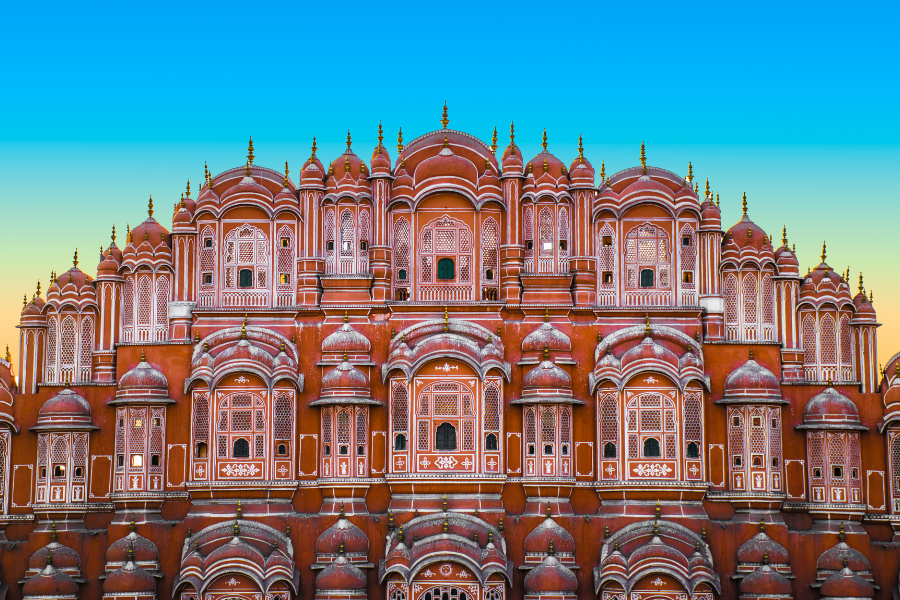
10. The Famous Pink Color Why is Jaipur called the Pink City? The answer lies in the 19th century. In 1876, the Prince of Wales, later King Edward VII, visited Jaipur. Maharaja Sawai Ram Singh II ordered the city to be painted in a distinctive terracotta pink color to welcome the royal visitor. Pink was traditionally associated with hospitality. The color became so strongly associated with Jaipur that regulations were subsequently used to preserve the distinctive appearance of the old city. The nickname Pink City has remained ever since.
11. City Palace The City Palace is one of Jaipur's most important historic complexes. Located within the old city, it served as the principal royal residence and administrative center. Construction began under Sawai Jai Singh II and continued under later rulers. The complex combines: Rajput architecture Mughal influences Courtyards Gardens Palaces Decorative gateways The City Palace reflects Jaipur's transformation from a newly founded capital into a sophisticated royal city.
12. Hawa Mahal Perhaps Jaipur's most recognizable building is the Hawa Mahal, or Palace of Winds. It was built in 1799 during the reign of Sawai Pratap Singh. The structure is famous for its elaborate façade containing numerous small windows. These windows allowed royal women to observe processions and street life without being easily seen from outside, in accordance with the social customs of the period. The building's design also helped circulate air through the structure, contributing to its name, "Palace of Winds." Its honeycomb-like façade has become one of the most iconic images of India.
13. Jantar Mantar Jaipur's Jantar Mantar is one of the most extraordinary scientific monuments in India. It was built by Sawai Jai Singh II as part of his interest in astronomy. The Jaipur observatory contains enormous astronomical instruments designed to measure: Time Celestial positions Movements of astronomical bodies Solar measurements The most famous instrument is the Samrat Yantra, a gigantic sundial. Jantar Mantar demonstrates that Jaipur's history was not solely about royal palaces and warfare. Science and intellectual activity were also central to the city's development.
14. Jal Mahal Another famous Jaipur landmark is Jal Mahal, or the Water Palace. It stands in Man Sagar Lake between Jaipur and Amber. Much of the palace appears to sit directly on the water, creating one of the city's most recognizable landscapes. The structure is associated with the period of Jaipur's Rajput rulers and reflects the royal tradition of building pleasure and retreat spaces around water.
15. Nahargarh Fort On the hills overlooking Jaipur stands Nahargarh Fort. The fort was established in the 18th century during the early development of Jaipur. Its elevated position provided strategic protection and spectacular views of the growing city. Nahargarh later became associated with royal retreats and summer residences. Its architecture reflects the evolution of Jaipur's Rajput courtly culture.
16. Jaigarh Fort Another major fort is Jaigarh Fort, located in the Aravalli hills near Amber. Jaigarh was particularly important for military purposes. The fort is famous for its enormous cannon, traditionally known as Jaivana. Jaigarh protected the Amber region and the royal capital's strategic approaches. Together, Amber Fort, Jaigarh Fort, and Nahargarh Fort demonstrate the military landscape surrounding Jaipur.
17. Jaipur and the Mughal Empire The history of Jaipur cannot be separated from its relationship with the Mughal Empire. Kachwaha rulers developed close political and matrimonial relationships with the Mughals. One of the most famous examples was Raja Man Singh I, who became a prominent general under Emperor Akbar. The Kachwahas benefited from their relationship with the Mughal court, gaining prestige, territory, and political influence. At the same time, they maintained their own traditions and royal identity. This interaction between Rajput and Mughal cultures can be seen in Jaipur's architecture.
18. Jaipur Under Later Rajput Rulers After Jai Singh II's death in 1743, Jaipur continued to be ruled by members of the Kachwaha dynasty. The city experienced periods of prosperity as well as political instability. The 18th century was a turbulent period in northern India because Mughal power was declining and various regional powers were competing for influence. Jaipur had to navigate relationships with: Marathas Mughals Other Rajput states Afghan forces British power Despite these challenges, Jaipur retained its importance.
19. Jaipur and the British During the 19th century, British influence expanded throughout Rajasthan. The princely state of Jaipur entered into a treaty relationship with the British. Jaipur remained a princely state, meaning that its Maharaja retained internal authority under the broader political supremacy of the British Crown. The British did not directly administer Jaipur in the same way they administered British provinces. This allowed the Jaipur royal court to continue playing an important role in the city's cultural and political life.
20. Sawai Ram Singh II and Modernization Sawai Ram Singh II, who ruled Jaipur during much of the 19th century, played an important role in modernization. His reign is associated with developments in: Education Infrastructure Photography Public works Arts and crafts Urban administration Ram Singh II was himself interested in photography and became one of the notable early Indian royal photographers. His reign also coincided with the famous 1876 visit of the Prince of Wales and the painting of Jaipur pink.
21. Jaipur's Artistic Traditions Jaipur became one of India's important centers of traditional arts and crafts. Jewelry The city became especially famous for gemstone cutting and jewelry. Textiles Jaipur and surrounding regions developed distinctive traditions of: Block printing Tie-dye Bandhani Embroidery Blue Pottery Jaipur's blue pottery is particularly famous for its distinctive colors and decorative patterns. Miniature Painting The Jaipur school of miniature painting developed within the broader Rajasthani artistic tradition. These crafts remain important to Jaipur's cultural and economic identity.
22. Jaipur After Indian Independence India became independent in 1947. Jaipur was initially part of the process of political integration that brought the princely states of Rajasthan into the Indian Union. The former Jaipur state eventually became part of Rajasthan. Jaipur was designated the capital of the new state. The role of the Maharaja changed dramatically. Royal political authority disappeared, but the royal family's cultural and historical significance continued.
23. Jaipur as the Capital of Rajasthan Jaipur's importance increased after independence because it became the administrative capital of Rajasthan. Government institutions, universities, businesses, hospitals, and modern infrastructure expanded. The city gradually developed beyond its historic walls. New residential neighborhoods appeared, while the old city remained an important commercial and cultural center.
24. Jaipur's Transformation into a Modern City During the late 20th and early 21st centuries, Jaipur experienced rapid urban growth. The city developed into a major center for: Tourism Education Information technology Business Healthcare Hospitality Handicrafts Jewelry Modern Jaipur now extends far beyond the original planned city. Yet the historic walled city remains central to its identity.
25. Jaipur as a UNESCO World Heritage City The historic walled city of Jaipur was inscribed on the UNESCO World Heritage List in 2019. Its recognition reflects the significance of its: Planned urban design Historic architecture Commercial streets Public squares Traditional markets Cultural traditions Jaipur is particularly important because its original urban plan remains visible in the structure of the modern historic city.
26. The Architecture of Jaipur Jaipur's architecture represents a fascinating combination of different traditions. Rajput influences Seen in: Forts Chhatris Courtyards Defensive structures Mughal influences Seen in: Arches Gardens Decorative details Palace layouts Traditional Hindu architecture Seen in: Temple design Vastu-based planning Symbolic geometry European influences These became increasingly visible during the colonial period. The result is a distinctive architectural identity that is difficult to confuse with any other Indian city.
27. Jaipur's Food Culture Jaipur's history is also reflected in its food. Traditional Rajasthani cuisine developed in an environment where water was scarce and ingredients had to be used efficiently. Popular dishes include: Dal baati churma Gatte ki sabzi Ker sangri Bajre ki roti Ghevar Mawa kachori The city's royal traditions also contributed to elaborate preparations associated with the former courts. Modern Jaipur combines traditional Rajasthani food with cuisines brought by visitors, migrants, and the city's growing hospitality industry.
28. Festivals and Cultural Life Jaipur remains a major center of Rajasthan's cultural traditions. Important celebrations include: Diwali Holi Teej Gangaur Makar Sankranti The Teej and Gangaur festivals are particularly associated with Rajasthan's traditional culture. The city also hosts cultural festivals, literature events, music performances, craft fairs, and tourism events.
29. Jaipur's Famous Historic Landmarks A historical tour of Jaipur can include: Amber Fort City Palace Hawa Mahal Jantar Mantar Jal Mahal Nahargarh Fort Jaigarh Fort Albert Hall Museum Gaitore The historic walled city and its bazaars Together, these monuments tell the story of Jaipur's development from a planned royal capital into a modern city.
30. Timeline of Jaipur's History Year/Period Event Before 18th century Amber serves as Kachwaha capital 1688 Birth of Sawai Jai Singh II 1699 Jai Singh II becomes ruler of Amber 1727 Jaipur founded 18th century Planned city and major monuments develop 1743 Death of Sawai Jai Singh II Late 18th century Jaipur develops as a major Rajput center 1799 Hawa Mahal constructed 19th century British influence expands 1876 Jaipur painted pink for Prince of Wales's visit Early 20th century Continued modernization 1947 Indian independence 1949 Jaipur becomes part of Rajasthan's political integration Post-1949 Jaipur becomes capital of Rajasthan 2019 Historic Jaipur recognized as a UNESCO World Heritage Site
31. Why Jaipur Is Historically Important Jaipur is significant for several reasons.
1. It was a planned city Its original design demonstrates sophisticated 18th-century urban planning.
2. It represents Rajput power The city reflects the political and cultural achievements of the Kachwaha rulers.
3. It demonstrates Rajput-Mughal interaction Its architecture and court culture reveal centuries of exchange between different traditions
. 4. It was a center of science Jai Singh II's astronomical observatories make Jaipur important in the history of Indian scientific thought.
5. It preserved traditional crafts Jewelry, textiles, pottery, painting, and other crafts remain central to the city's identity.
6. It successfully adapted to modern India After independence, Jaipur transitioned from a princely capital into the administrative and economic capital of Rajasthan.
Conclusion The history of Jaipur is the story of a city deliberately created with a vision. Founded in 1727 by Maharaja Sawai Jai Singh II, Jaipur began as a carefully planned Rajput capital and developed into one of India's most recognizable historic cities. Its relationship with the Mughal Empire, its magnificent forts and palaces, its astronomical observatory, its famous pink architecture, and its vibrant craft traditions have all contributed to its unique character. Unlike cities whose history is hidden beneath layers of modern development, Jaipur's history remains visible in its streets. The walls of the old city, the markets of Johari Bazaar, the façade of Hawa Mahal, the instruments of Jantar Mantar, the palaces of the City Palace, and the forts overlooking the Aravallis together tell a story spanning nearly three centuries. Jaipur is not simply the Pink City—it is a living record of Rajput ambition, scientific curiosity, artistic creativity, royal culture, and India's transition from the princely era to the modern nation.