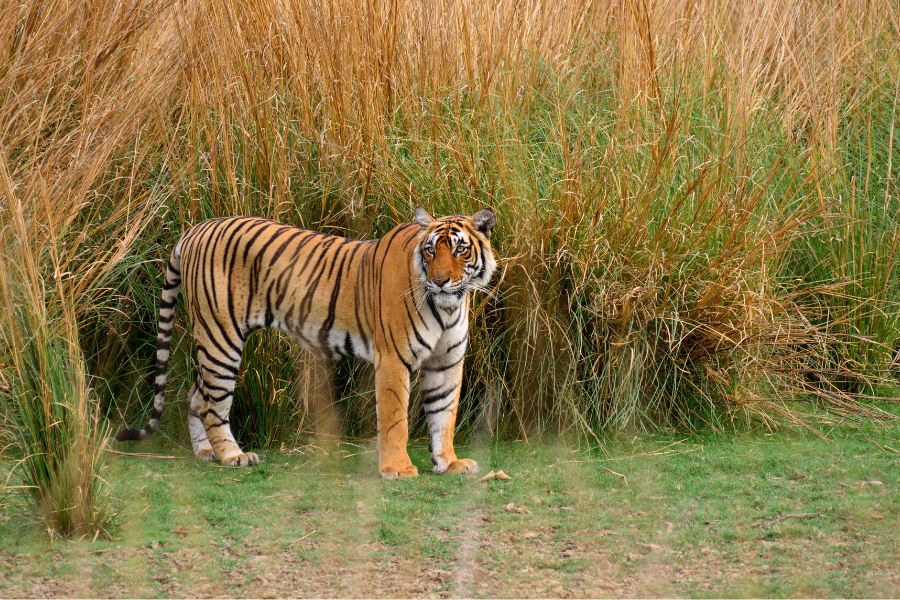
There are some journeys that stay with you long after you return home. A tiger safari is one of them. The moment you enter the forest, something changes. The sounds of traffic disappear, the air feels different, and every movement in the bushes seems to carry a story. You are no longer simply visiting a destination—you are entering a world where nature sets the rules. A distant alarm call, fresh paw prints on a muddy trail, the sudden silence of birds, or a glimpse of orange and black between the trees can turn an ordinary morning into an unforgettable adventure. Welcome to the wild world of tracks, trails, and tigers.

The Call of the Jungle
A tiger safari begins long before you see a tiger.
It begins with anticipation.
The early morning alarm rings while the sky is still dark. Outside, the forest is quiet and cool. You prepare for the safari, knowing that there are no guarantees. Unlike a zoo or wildlife park, the jungle does not operate on a schedule.
The tiger may be resting deep inside the forest. It may be walking through tall grass. It may be following a trail toward water. Or it may remain completely hidden.
And that uncertainty is exactly what makes a safari exciting.
As the safari vehicle enters the forest, the landscape slowly comes alive. Birds call from the trees, deer move cautiously through the undergrowth, and monkeys watch from branches overhead.
Every sound becomes meaningful.
Every track becomes a clue.
Every bend in the trail creates a new possibility.
Following the Tracks
One of the most fascinating parts of a tiger safari is learning to read the forest.
Tigers are masters of stealth. They can move through dense vegetation almost silently, which means visitors often discover their presence indirectly.
A safari guide or naturalist may suddenly stop the vehicle and point toward the ground.
Pugmarks.
A set of footprints in the soft earth can reveal that a tiger recently passed through the area. The size and shape of the tracks can provide clues, while the direction may indicate where the animal was heading.
But tiger tracking isn't simply about following footprints.
Experienced guides observe the entire forest.
They look for:
Fresh pugmarks
Alarm calls from deer and monkeys
Scratch marks on trees
Scattered feathers or other signs of wildlife activity
Movement in tall grass
Trails leading toward water sources
Changes in the behavior of prey animals
The forest is full of clues. You simply have to learn how to notice them.
The Forest Has Its Own Language
A tiger safari teaches you that wildlife communicates constantly.
You might hear a sudden warning call from a spotted deer. Somewhere deeper in the forest, another animal responds.
Your guide immediately slows down.
Everyone becomes quiet.
You wait.
Nothing happens.
Then another alarm call echoes through the trees.
The excitement rises.
Perhaps the tiger is nearby. Perhaps it has already crossed the trail. Maybe it is watching from somewhere hidden in the vegetation.
This is one of the magical aspects of a safari: the anticipation can be just as thrilling as the sighting itself.
Even when the tiger remains unseen, the experience of understanding its presence can be deeply rewarding.
The Moment You See a Tiger
And then, sometimes, the jungle rewards your patience.
At first, it may be only a movement.
A flicker of orange between green leaves.
You look again.
There it is.
A tiger.
For a few seconds, nobody speaks.
The animal walks calmly through the forest, completely unaware—or perhaps completely unconcerned—with the excitement inside the safari vehicle.
Its powerful shoulders move beneath its striped coat. Its ears turn toward distant sounds. Its eyes scan the surroundings.
Then it stops.
For a moment, you make eye contact.
It is difficult to describe that feeling.
The tiger isn't performing for visitors. It isn't posing for photographs. It is simply living its life in its natural habitat.
That is what makes the encounter so powerful.
More Than Just a Tiger
Although tigers are often the stars of the safari, the jungle has much more to offer.
A successful safari is not measured only by whether you see a tiger.
You may encounter a herd of chital deer moving through the grassland. Their spotted coats blend beautifully with the landscape.
You might spot a sambar deer, larger and darker, standing quietly beneath the trees.
High in the branches, langurs may leap from tree to tree, while colorful birds add flashes of movement to the forest.
Depending on the reserve and season, you may also encounter:
Sloth bears
Leopards
Wild boars
Gaur
Crocodiles
Various species of deer
Monkeys and langurs
Eagles, owls, kingfishers, and other birds
Every animal contributes to the ecosystem.
The tiger may be the attraction that brings visitors into the forest, but the forest itself is the real protagonist.
The Beauty of the Jungle
One of the biggest surprises for first-time safari travelers is how beautiful the landscape can be.
Tiger habitats are not always the dense, dark jungles people imagine from movies. Depending on the reserve, you may travel through open grasslands, dry forests, bamboo patches, riverbanks, wetlands, and woodland trails.
Morning light filtering through trees can transform the landscape.
Mist may hover above a waterhole.
The golden sunlight of late afternoon can turn the grass into shades of amber.
Even when there are no animals in sight, the scenery itself can be spectacular.
Sometimes, the most memorable photograph isn't of a tiger at all—it is a photograph of the forest where you spent hours waiting for one.
Why Waterholes Matter
During warmer months, water becomes particularly important for wildlife.
Waterholes and rivers can become gathering places where different species come to drink, cool down, or search for food.
A tiger may visit a water source after a long walk through its territory. Deer and wild boar may arrive cautiously. Birds may gather around the edges.
For safari visitors, these locations can provide fascinating opportunities to observe natural behavior.
But patience is essential.
You might wait for an hour and see nothing.
Then, suddenly, the forest comes alive.
A deer emerges from the bushes.
Birds begin calling.
The atmosphere changes.
And everyone looks toward the same patch of vegetation.
The Art of Patience
A tiger safari isn't about rushing from one location to another.
It is about slowing down.
Modern life trains us to expect immediate results. We search, click, order, and receive almost instantly.
The jungle works differently.
You may spend hours driving along forest tracks without seeing a tiger.
At first, you might feel disappointed.
But gradually, you begin noticing other things—the shape of trees, bird calls, animal tracks, butterflies, insects, and subtle movements in the vegetation.
You start to understand that a safari isn't a tiger-spotting competition. It is an opportunity to observe nature.
And when the tiger finally appears, the patience makes the moment even more meaningful.
Responsible Tourism in Tiger Country
The excitement of seeing a tiger comes with an important responsibility.
Wild animals are not entertainers. They should never be pressured, disturbed, or chased simply to provide visitors with a better photograph.
Responsible safari tourism means respecting the rules of the forest.
Visitors should:
Keep a safe and respectful distance from wildlife.
Follow instructions from guides and park authorities.
Avoid shouting or making unnecessary noise.
Never attempt to feed animals.
Avoid littering.
Stay inside designated safari vehicles or areas.
Never encourage drivers to chase wildlife.
Avoid using flash photography when prohibited.
Respect other visitors and their wildlife-viewing opportunities.
A great wildlife experience is one where the animal remains comfortable and undisturbed.
Capturing the Experience Through Photography
A tiger in the wild can be a challenging subject to photograph.
The lighting may be low. The animal may be partially hidden. It may move quickly or disappear behind vegetation within seconds.
Instead of focusing only on getting the perfect photograph, enjoy the encounter first.
If you are photographing wildlife, consider:
Use a fast shutter speed:
Animals can move unexpectedly, and a faster shutter speed helps capture sharp images.
Be patient:
Wait for the animal to enter a clear patch rather than constantly photographing through dense vegetation.
Watch the light:
Early morning and late afternoon often provide beautiful natural light.
Don't forget the surroundings:
A wider photograph showing the tiger within its habitat can tell a more compelling story than a tight portrait.
Most importantly, don't spend the entire sighting looking through your camera.
Some moments are better remembered with your own eyes.
The Magic of an Early Morning Safari
Early morning is one of the most atmospheric times to explore a tiger reserve.
The forest is cooler, birds are active, and the soft light creates a beautiful landscape.
As the sun rises, the forest gradually changes color.
You might see deer grazing in an open meadow, birds moving through the trees, or mist slowly disappearing from a waterhole.
There is also something special about the silence.
For a few hours, you are disconnected from notifications, traffic, meetings, and everyday routines.
You are simply sitting in a vehicle, listening to the forest.
And that can be surprisingly refreshing.
What to Carry on a Tiger Safari
A little preparation can make your safari more comfortable.
Consider carrying:
Comfortable, neutral-colored clothing
A hat or cap
Sunglasses
Sunscreen
Drinking water
Binoculars
A camera with an appropriate zoom lens
Extra batteries or a power bank
Light snacks, where permitted
A light jacket during cooler months
Any required identification or permit documents
Avoid wearing extremely bright colors if your safari operator or park recommends neutral clothing. More importantly, always follow the specific guidelines of the reserve you are visiting.
Choosing the Right Season
The best time for a tiger safari depends on the destination, local climate, park regulations, and your priorities.
In many Indian tiger reserves, the warmer months can offer good opportunities for wildlife sightings because vegetation becomes thinner and animals may spend more time near water.
The cooler months, however, can provide a more comfortable safari experience, with pleasant mornings and beautiful landscapes.
Monsoon conditions are another consideration. Many tiger reserves have seasonal closures or restricted access during the monsoon period.
Before planning your trip, check the current opening dates, safari rules, permits, and weather conditions for the specific reserve.
A Journey That Changes You
A tiger safari is ultimately about more than seeing a magnificent predator.
It is about understanding the delicate relationship between animals, forests, water, and people.
When you see a tiger walking through its natural habitat, you are witnessing one small part of a much larger ecosystem.
The deer need the forest.
The birds need the trees.
The trees depend on water and soil.
And the tiger depends on a healthy ecosystem with enough prey and a secure habitat.
Protecting the tiger therefore means protecting the landscape around it.
Tracks, Trails and Memories
Eventually, the safari vehicle turns back toward the park gate.
The jungle begins to fade behind you.
You may have photographs on your camera, but the memories are far more than pictures.
You remember the first pugmark.
The sudden alarm call.
The long silence.
The anticipation.
The moment when orange and black appeared through the trees.
And perhaps most importantly, you remember the feeling of being a temporary visitor in a world that existed long before you arrived.
That is the true magic of a tiger safari.
Tracks lead to trails. Trails lead deeper into the jungle. And somewhere beyond those trails, a tiger continues to roam—wild, powerful, and free.
Final Thought
If you are planning your first tiger safari, go with an open mind. Don't measure the experience only by the number of tigers you see. Listen to the forest, watch the smaller animals, learn from your guide, respect the wildlife, and allow yourself to be surprised.
Because sometimes the greatest adventure isn't simply finding the tiger.
It's discovering the jungle along the way.