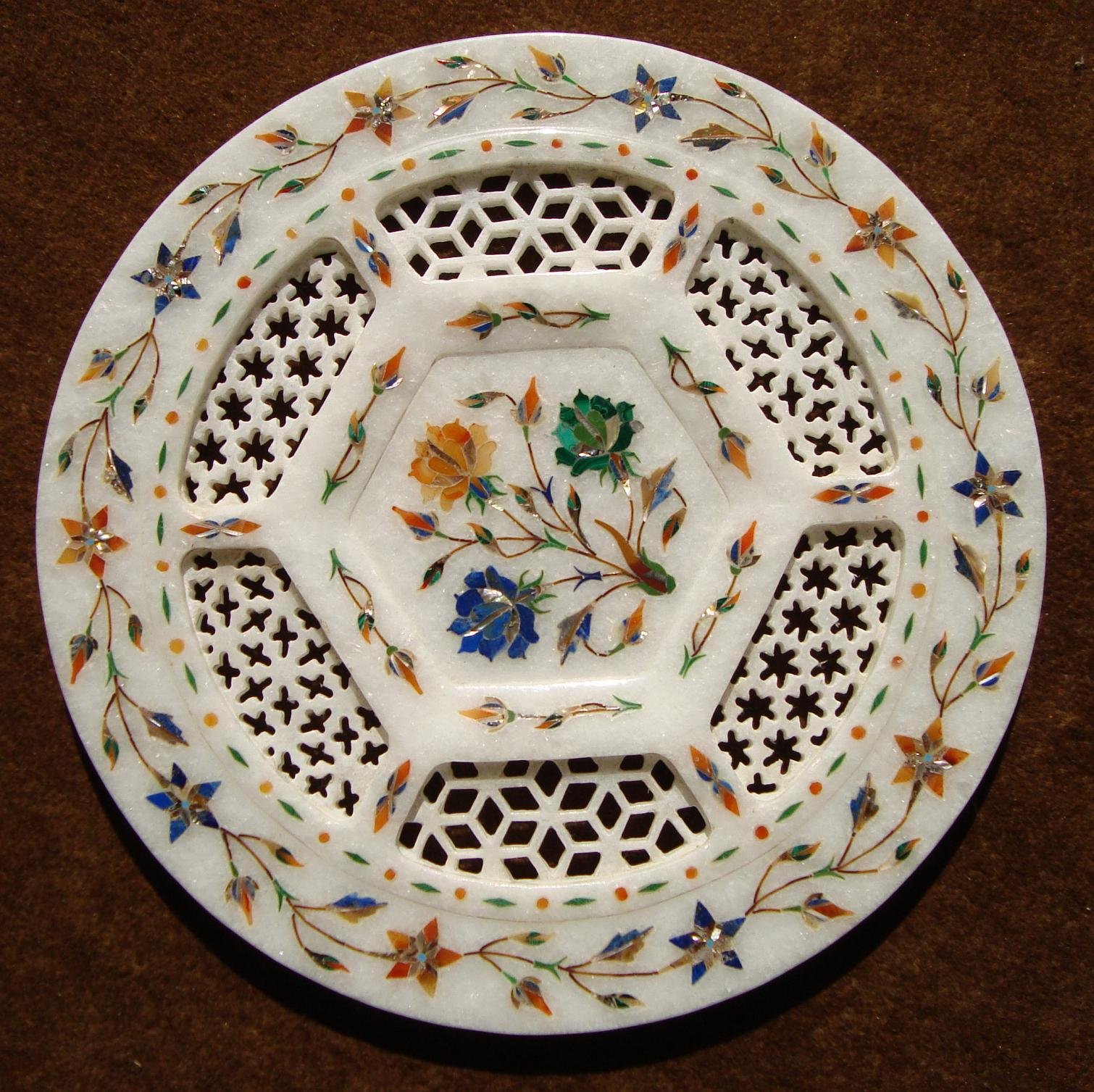
When travelers visit Agra to see the magnificent Taj Mahal, they often notice something beyond its famous white marble façade: the delicate floral designs, geometric patterns, and colorful stone decorations embedded into the marble. This beautiful decorative technique is known as marble inlay work, commonly associated with the Italian term Pietra Dura. In Agra, the craft developed into a distinctive Mughal-era artistic tradition and continues to be practiced by skilled artisans today. For visitors interested in Indian culture, history, architecture, and traditional handicrafts, seeing Agra's marble inlay work offers a fascinating opportunity to understand the craftsmanship behind one of India's most famous monuments. In this guide, we will explore the history of Agra marble inlay, how the craft is made, the stones used, where tourists can see it, what to buy, and how to identify quality workmanship.

What Is Marble Inlay Work?
Marble inlay is a decorative technique in which small pieces of colored or semi-precious stone are carefully cut and fitted into a marble surface to create intricate designs.
Unlike painting, the design is physically embedded into the marble.
Artisans first create a pattern on the marble and then carefully carve shallow recesses. Small pieces of colored stone are cut into precise shapes and fitted into these spaces. The surface is then polished until the marble and stones become smooth and appear almost like a single surface.
The result can include:
- Flowers and leaves
- Vines and botanical designs
- Geometric patterns
- Borders and decorative frames
- Birds and other motifs
- Abstract designs
- Calligraphic decoration
The extraordinary precision required makes traditional marble inlay a highly skilled craft.
What Is Pietra Dura?
Pietra dura is an Italian term generally used for a technique involving the inlay of carefully cut, polished colored stones into a base material, often marble.
The technique became particularly famous in Europe, but related stone-inlay traditions existed in different cultures. During the Mughal period, sophisticated decorative stone inlay became an important feature of imperial architecture in India.
The Taj Mahal is one of the world's best-known examples.
In the context of Agra, the terms marble inlay, stone inlay, and Pietra Dura are often used when describing this traditional decorative craft.
The History of Marble Inlay in Agra
Agra became an important center of architecture and artistic craftsmanship during the Mughal period.
The Mughal emperors supported architects, craftsmen, painters, stoneworkers, and other specialists who contributed to the construction and decoration of royal buildings.
During the reign of Shah Jahan, marble architecture and sophisticated decorative techniques reached an especially high level.
The Taj Mahal, constructed in the 17th century, demonstrates this extraordinary attention to detail.
Its white Makrana marble is decorated with intricate floral stone inlay, creating colorful designs across selected architectural surfaces.
The artistic tradition continued in Agra after the construction of the Taj Mahal. Generations of craftsmen developed and preserved techniques associated with marble carving and stone inlay.
Today, Agra remains particularly well known for marble handicrafts inspired by Mughal architectural decoration.
Marble Inlay Work and the Taj Mahal
The Taj Mahal is the most famous monument associated with Agra's marble inlay tradition.
Look closely at the monument and you can see delicate floral motifs made from colored stones embedded into the white marble.
These designs were not simply painted onto the building. Instead, individual pieces of stone were shaped and inserted into the marble.
This gives the decoration a distinctive appearance and remarkable durability.
The floral motifs are particularly striking because they combine the pure white background of the marble with subtle colors from different stones.
How Is Agra Marble Inlay Made?
Traditional marble inlay is a labor-intensive process requiring considerable patience and precision.
Here is a simplified overview of the traditional process.
1. Selecting the Marble
The artisan begins with a suitable piece of marble.
White marble is especially popular because it provides a clean background against which colorful stones stand out.
The quality of the marble affects the final appearance of the product.
2. Creating the Design
The artisan develops a design or works from an established traditional pattern.
Common designs include:
- Flowers
- Leaves
- Creeping vines
- Geometric patterns
- Mughal-inspired motifs
- Decorative borders
For larger pieces, the design may be carefully transferred onto the marble surface.
3. Cutting the Marble
Using specialized tools, the artisan creates shallow grooves or cavities in the marble according to the design.
The cuts must be extremely precise.
Even a small mistake can affect the fit of the stone.
4. Selecting Colored Stones
Different stones are selected according to the colors and details required by the design.
Depending on the piece, artisans may use stones such as:
- Lapis lazuli
- Malachite
- Carnelian
- Jasper
- Turquoise
- Agate
- Mother-of-pearl and other decorative materials
The exact materials can vary considerably between workshops and products.
5. Cutting the Stones
This is one of the most demanding parts of the process.
The selected stones are cut into tiny shapes corresponding to the design.
For a detailed flower, an artisan may need many individual pieces.
Each piece must fit accurately into its designated space.
6. Fitting the Pieces
The colored stones are carefully fitted into the carved marble.
Traditional craftsmanship emphasizes close fitting and precise placement.
When the pieces are properly fitted, the design begins to appear as a complete image.
7. Polishing
The final stage involves smoothing and polishing the surface.
The objective is to create a smooth finish where the marble and inlaid stones sit together harmoniously.
A well-finished piece can have a beautiful depth and shine.
What Stones Are Used in Agra Marble Inlay?
One of the most fascinating aspects of the craft is the use of different colored stones.
Lapis Lazuli
Lapis lazuli is recognized for its deep blue color and can create a striking contrast against white marble.
Carnelian
Carnelian is typically associated with warm orange, red, and reddish-brown tones.
Malachite
Malachite is known for its distinctive green color and natural banding.
Turquoise
Turquoise provides blue or blue-green tones in decorative designs.
Jasper
Jasper occurs in several colors and can be used for flowers, leaves, borders, and other details.
Agate
Agate can provide a variety of natural colors and patterns.
The precise stone selection depends on the artisan, design, availability, and type of product being produced.
Why Is Agra Famous for Marble Inlay?
Agra's association with marble inlay comes from its Mughal architectural heritage.
The city became a major center of imperial construction and craftsmanship, and the artistic traditions developed around Mughal monuments continued through generations.
The Taj Mahal provided perhaps the most famous example of the technique, helping establish Agra's reputation for marble craftsmanship.
Today, visitors can find marble inlay used in decorative products such as:
- Tabletops
- Coasters
- Jewelry boxes
- Decorative plates
- Trays
- Vases
- Picture frames
- Small monuments
- Animal and floral figures
These products allow travelers to take home a piece of Agra's traditional craft.
Where Can Tourists See Marble Inlay in Agra?
Visitors don't necessarily have to limit their experience to seeing the finished decoration at the Taj Mahal.
Agra has workshops and handicraft establishments where visitors can learn about traditional marble work and watch artisans demonstrate aspects of the process.
Popular areas associated with handicrafts include parts of:
- Fatehabad Road
- Taj Ganj
- Eastern Gate area
- Agra's traditional handicraft markets
When visiting a workshop, travelers should remember that demonstrations and shopping experiences vary from place to place.
It is useful to compare several shops before making an expensive purchase.
What Can You Buy?
Marble inlay products come in many sizes and price ranges.
Small Souvenirs
For travelers with limited luggage space, smaller items can be practical choices.
Examples include:
- Coasters
- Small boxes
- Miniature decorative plates
- Paperweights
- Small tiles
- Small floral panels
These are easier to transport and can make attractive souvenirs.
Medium-Sized Decorative Pieces
Travelers looking for something more substantial can consider:
- Serving trays
- Decorative bowls
- Tabletop panels
- Vases
- Picture frames
These pieces can showcase more detailed inlay work.
Large Pieces
Some workshops produce larger decorative tables and furniture.
These can contain highly detailed designs and require considerably more care when transporting them internationally.
If you purchase a large item, ask the seller about packing, shipping, insurance, and customs requirements for your destination country.
How Much Does Agra Marble Inlay Cost?
There is no single fixed price for marble inlay products.
Prices can vary greatly depending on:
- Size
- Design complexity
- Type of marble
- Type and quantity of stones
- Number of inlaid pieces
- Amount of handwork
- Finishing quality
- Whether the item is handmade or machine-assisted
- Reputation of the workshop or seller
A small souvenir can cost relatively little, while a large, highly detailed handmade tabletop can cost substantially more.
Instead of judging an item only by its size, examine the quality and complexity of the workmanship.
How to Identify Good Marble Inlay Work
If you are planning to buy marble inlay in Agra, take some time to inspect the product.
1. Look at the Stone Fitting
The colored stones should fit neatly into the marble.
Large visible gaps or rough edges can indicate lower-quality finishing.
2. Check the Surface
Run your fingers gently across the surface.
Good finishing should generally feel smooth rather than excessively rough or uneven.
3. Examine the Design
Look closely at flowers, leaves, borders, and other details.
Fine work usually shows careful symmetry and precision.
4. Ask About the Materials
Ask the seller what type of marble and stones were used.
If the material matters to you, ask specifically whether the stones are natural.
5. Ask Whether It Is Handmade
Not every decorative product sold in a craft shop will involve the same amount of traditional handwork.
Ask how the piece was made and what parts were completed by hand.
Handmade vs Machine-Made Marble Inlay
Modern production methods can make marble products faster and more affordable.
Traditional handmade work, however, generally involves significantly more individual craftsmanship.
A tourist interested specifically in traditional Indian craftsmanship should ask:
“Is this completely handmade?”
You can also ask:
“Which parts are handmade?”
This can help you understand what you are purchasing and why two visually similar products may have very different prices.
Marble Inlay vs Marble Carving
These two techniques are sometimes confused.
Marble Inlay
Colored stones are inserted into a marble surface to create a design.
Marble Carving
The marble itself is cut, shaped, or sculpted to create patterns, textures, or three-dimensional forms.
The Taj Mahal incorporates both marble craftsmanship and decorative techniques, but its famous floral decoration is particularly associated with stone inlay.

Why Are Floral Designs So Common?
Floral decoration is an important feature of Mughal artistic traditions.
At the Taj Mahal, stylized flowers and plants appear throughout the architectural decoration.
These designs create a sense of elegance while adding color to the otherwise predominantly white marble structure.
Agra artisans continue to produce floral patterns inspired by this architectural heritage.
You will frequently see roses, lilies, leaves, vines, and other stylized botanical forms in modern marble handicrafts.
Marble Inlay as a Cultural Experience
For tourists, visiting a marble workshop can be more than a shopping trip.
It can provide an opportunity to understand the relationship between:
Mughal architecture → traditional craftsmanship → modern Agra handicrafts
Seeing how a small piece of stone is transformed into a detailed flower can give visitors a greater appreciation for the work involved in the Taj Mahal's decorative surfaces.
For photographers and culture-focused travelers, artisans working with marble and colored stones can also provide an interesting glimpse into a traditional craft.
Tips for Tourists Buying Marble Inlay in Agra
Before purchasing, keep these practical tips in mind.
Compare Prices
Visit more than one shop before buying an expensive item.
Don't Rush
Take time to inspect the workmanship.
Ask About Shipping
Large marble items can be heavy and difficult to carry.
If you are an international traveler, ask whether the shop provides international shipping.
Check the Packaging
Marble can be damaged by impact during transportation.
Ask how the item will be packed.
Keep Your Receipt
For expensive purchases, retain the invoice or receipt.
Ask About Stone Authenticity
If the seller makes specific claims about the type or value of stones, ask for those details in writing if they are important to your purchase.
Consider Your Luggage
A beautiful marble tabletop may not be the most convenient souvenir for someone traveling with limited luggage!
Best Time to Visit a Marble Workshop
Marble workshops generally fit easily into a daytime Agra sightseeing itinerary.
A typical day might include:
Morning: Taj Mahal
Late morning: Agra Fort
Afternoon: Marble inlay workshop
Evening: Mehtab Bagh or local market
If your schedule includes a private car and driver, a workshop visit can often be incorporated between major sightseeing stops.
Marble Inlay on a Golden Triangle Tour
Travelers taking the classic Delhi–Agra–Jaipur Golden Triangle Tour can dedicate part of their Agra visit to traditional handicrafts.
A 2-day Agra itinerary could include:
Day 1
- Arrive in Agra
- Visit Agra Fort
- Explore local markets
- Experience an Agra marble workshop
Day 2
- Sunrise visit to the Taj Mahal
- Breakfast
- Visit another heritage attraction
- Continue to Jaipur or return to Delhi
For travelers particularly interested in Indian arts and crafts, adding a marble inlay experience can make the Agra portion of the journey more culturally focused.
Why Marble Inlay Makes a Special Agra Souvenir
A souvenir becomes more meaningful when it represents the destination you visited.
Marble inlay is strongly connected with Agra's architectural heritage and the artistic traditions associated with the Taj Mahal.
Instead of buying a generic souvenir, travelers can choose a handcrafted marble item that reflects:
- Mughal-inspired design
- Indian craftsmanship
- Agra's artistic heritage
- Traditional stonework
- Floral architectural decoration
A small marble inlay box or coaster can therefore serve as both a decorative object and a reminder of your visit to Agra.
Frequently Asked Questions
What is Agra marble inlay?
Agra marble inlay is a traditional decorative craft in which pieces of colored stone are fitted into marble to create intricate patterns, particularly floral and geometric designs.
Is marble inlay the same as Pietra Dura?
The terms are closely related in the context of decorative stone inlay. Pietra dura is a broader term associated with the use of cut and polished stones in inlaid designs, while Agra's marble inlay refers specifically to the local craft tradition associated with marble architecture and handicrafts.
Can I see marble inlay at the Taj Mahal?
Yes. The Taj Mahal contains elaborate stone-inlay decoration, particularly floral designs on its marble surfaces.
Can tourists visit marble inlay workshops in Agra?
Yes. Agra has handicraft shops and workshops where visitors can see demonstrations and purchase marble products. Experiences vary between establishments.
Is Agra marble inlay handmade?
Traditional marble inlay is highly labor-intensive and involves skilled handwork. However, products available commercially can be made using different combinations of traditional and modern techniques, so tourists should ask the seller about the specific piece.
What is the best marble inlay souvenir?
The answer depends on your budget, luggage space, and preferences. Small boxes, coasters, decorative plates, and tabletop pieces are among the commonly available options.
Can I take marble handicrafts abroad?
Generally, tourists can purchase and transport many marble handicrafts, but international travelers should check the customs and import rules of their destination country. Large or valuable pieces may require additional documentation and shipping arrangements.
Final Thoughts
Agra's marble inlay tradition is much more than a shopping opportunity. It is a living connection to the city's architectural and artistic heritage.
The next time you visit the Taj Mahal, take a moment to look closely at the marble decoration. The colorful flowers and delicate patterns represent an extraordinary level of precision and craftsmanship.
Then, if time allows, visit a reputable local workshop and watch artisans demonstrate how small pieces of colored stone are transformed into intricate designs.
For travelers interested in history, architecture, culture, and authentic Indian handicrafts, Agra marble inlay is an experience worth adding to your itinerary.
From the grand marble surfaces of the Taj Mahal to the small handcrafted souvenirs found in Agra's markets, this traditional art continues to tell the story of the city's rich artistic heritage.