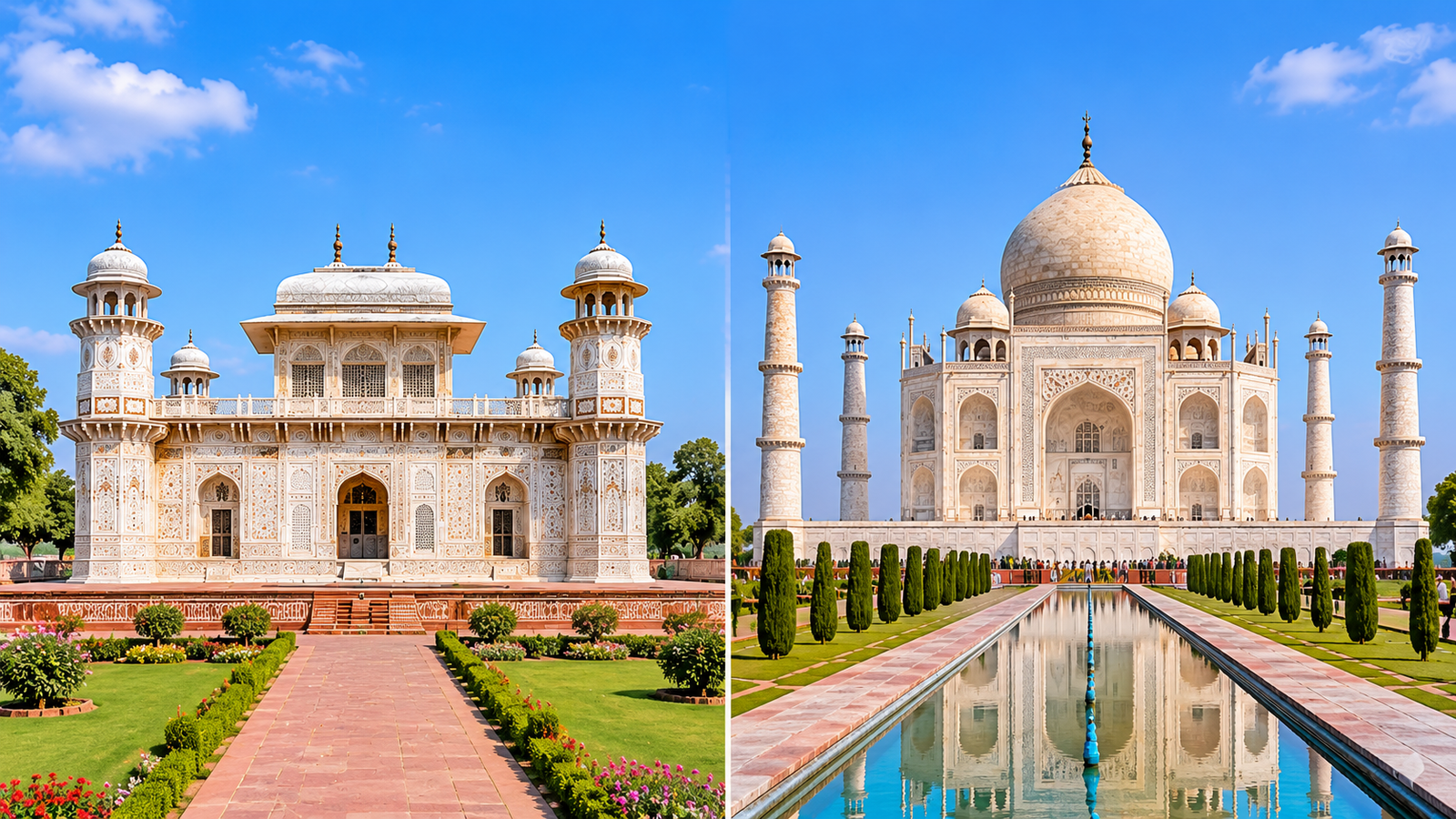
Agra is home to some of India's most extraordinary Mughal monuments, attracting visitors from around the world with their magnificent architecture, fascinating history and artistic beauty. While the Taj Mahal is undoubtedly the city's most famous attraction, another remarkable monument deserves equal attention: the Tomb of Itimad-ud-Daulah, popularly known as the Baby Taj. Both monuments stand along the banks of the Yamuna River and represent the finest achievements of Mughal architecture. They feature beautiful white marble, intricate stone inlay work, elegant domes and carefully designed gardens. However, their historical backgrounds, architectural styles, scale and artistic details make each monument unique. The Baby Taj was constructed several years before the Taj Mahal and is often considered an important architectural precursor to the world-famous mausoleum. Exploring both monuments offers visitors a deeper understanding of how Mughal architecture developed during the 17th century. If you are planning a trip to Agra, understanding the differences between these two monuments will make your sightseeing experience even more interesting.

1. What Is the Baby Taj?
The Baby Taj is the popular name for the Tomb of Itimad-ud-Daulah, a beautiful Mughal mausoleum situated on the eastern bank of the Yamuna River in Agra, Uttar Pradesh.
Built between 1622 and 1628, the monument was commissioned by Empress Nur Jahan in memory of her father, Mirza Ghiyas Beg, who served as an influential nobleman and minister in the Mughal Empire under Emperor Jahangir.
Mirza Ghiyas Beg received the prestigious title of Itimad-ud-Daulah, meaning "Pillar of the State." Following his death, his daughter Nur Jahan commissioned this magnificent tomb to honour his memory.
The Baby Taj is particularly famous for its white marble exterior, delicate marble lattice screens and elaborate decorations made from semi-precious stones. It is widely recognised as one of the earliest Mughal monuments constructed entirely of white marble.
Unlike the grand scale of the Taj Mahal, the Baby Taj has a more intimate appearance. Its elegant design, detailed craftsmanship and peaceful garden surroundings make it one of Agra's most beautiful historical attractions.
The monument is sometimes called a jewel box because of its delicate decorations and precious stone inlay work.

2. What Is the Taj Mahal?
The Taj Mahal is one of the most celebrated monuments in the world and a masterpiece of Mughal architecture. Located on the southern bank of the Yamuna River in Agra, it was commissioned by Mughal Emperor Shah Jahan in memory of his beloved wife, Mumtaz Mahal.
Construction began in 1632, following Mumtaz Mahal's death in 1631, and the principal mausoleum was completed around 1648. Work on the wider complex continued until approximately 1653.
Built primarily from white marble, the Taj Mahal is admired for its remarkable symmetry, magnificent central dome, elegant minarets, intricate floral decorations and beautiful Mughal gardens.
The monument combines elements of Persian, Islamic and Indian architectural traditions. Its harmonious proportions and detailed craftsmanship make it one of the finest examples of Indo-Islamic architecture.
The Taj Mahal is not simply a mausoleum but a complete architectural complex featuring a main gateway, formal gardens, a mosque, a guest house and the central marble tomb.
It was inscribed on the UNESCO World Heritage List in 1983 and continues to attract millions of visitors from across the globe.
3. Historical Differences Between the Baby Taj and Taj Mahal
Although both monuments belong to the Mughal period, they were constructed for different members of the imperial family and represent different historical moments.
History of the Baby Taj
The Baby Taj was commissioned by Empress Nur Jahan for her father, Mirza Ghiyas Beg. Construction took place between 1622 and 1628 during the reign of Emperor Jahangir.
Nur Jahan was one of the most influential women in Mughal history. She played an important role in imperial politics, court culture and architectural patronage.
Her father's mausoleum reflects her refined artistic taste and appreciation for Persian-influenced architecture. The monument also represents an important transition in Mughal architecture from the extensive use of red sandstone towards the increasing use of white marble.
History of the Taj Mahal
The Taj Mahal was commissioned by Emperor Shah Jahan following the death of his wife Mumtaz Mahal in 1631.
According to the traditional historical account, Shah Jahan wanted to create an extraordinary memorial in her honour. The result was one of the most ambitious architectural projects of the Mughal period.
Thousands of artisans, craftsmen, stone carvers, calligraphers and builders contributed to the construction.
The monument also became the finest expression of Shah Jahan's architectural vision, with an extraordinary emphasis on symmetry, proportions and elaborate marble decoration.
The two monuments therefore tell different stories: the Baby Taj commemorates a father through the devotion of his daughter, while the Taj Mahal commemorates an imperial wife through the patronage of her husband.
4. Architectural Differences Between the Baby Taj and Taj Mahal
The most fascinating aspect of visiting both monuments is observing how their architectural features compare.
Although they share several design elements, their size, layout, decoration and overall appearance are quite different.
A. Size and Overall Structure
Baby Taj
The Baby Taj is relatively small compared with the Taj Mahal. Its compact structure stands within a beautifully landscaped garden surrounded by boundary walls.
The central mausoleum is built on a raised platform, with four elegant corner towers and an attractive central structure. Its smaller proportions create a peaceful and intimate atmosphere.
Taj Mahal
The Taj Mahal is significantly larger and more monumental. Its main mausoleum stands on an elevated marble platform, with four tall minarets positioned at the corners.
The central dome dominates the entire structure, while the mosque, guest house, main gateway and formal gardens contribute to the grandeur of the complex.
The architectural scale of the Taj Mahal was designed to create a powerful visual impression from the moment visitors enter the main gateway.
B. Marble and Building Materials
Baby Taj
One of the most important architectural features of the Baby Taj is its use of white marble throughout the main structure.
It is recognised as the first Mughal building constructed entirely of white marble. Its exterior walls are decorated with delicate inlay work using colourful semi-precious stones.
Taj Mahal
The Taj Mahal also features extensive white marble construction, particularly in its central mausoleum.
However, the wider complex incorporates different building materials. The main gateway and surrounding structures use red sandstone, while the mosque and guest house combine red sandstone with white marble detailing.
The contrast between the red sandstone and white marble creates an elegant visual balance.
C. Pietra Dura and Stone Inlay Work
Both monuments are famous for their extraordinary stone inlay decorations.
Pietra dura, also known as Parchin Kari, is a decorative technique in which small pieces of coloured and semi-precious stones are carefully cut and fitted into marble surfaces to create intricate designs.
Baby Taj
The Baby Taj is particularly remarkable for its early and extensive use of this decorative technique.
Its walls feature floral arrangements, geometric patterns, vases, trees and other decorative motifs created using colourful stones.
The delicate craftsmanship can be appreciated throughout the exterior and interior of the mausoleum.
Taj Mahal
The Taj Mahal takes this decorative art to an even more sophisticated level.
Its marble surfaces feature detailed floral patterns, elegant borders and intricate geometric designs. Semi-precious stones such as lapis lazuli, jade and carnelian create beautiful patterns against the white marble.
The precision and refinement of these decorations demonstrate the exceptional artistic achievements of Mughal craftsmen.
D. Domes and Minarets
Baby Taj
The Baby Taj has a relatively low central roof structure and four attractive corner towers. Its overall design is more delicate and compact.
Unlike the Taj Mahal, it does not have the same monumental onion-shaped central dome.
Taj Mahal
The Taj Mahal is instantly recognisable because of its enormous central onion-shaped dome, which rises above the main mausoleum.
Four slender minarets stand at the corners of the marble platform. Their slightly outward-leaning design is an important feature of the monument's structural planning.
The combination of the central dome and minarets creates the iconic silhouette that makes the Taj Mahal one of the most photographed buildings in the world.
E. Marble Lattice Screens (Jali Work)
Another important similarity between the two monuments is their beautiful marble lattice work.
Baby Taj
The Baby Taj features delicate marble jali screens that allow natural light to enter the interior. Their finely carved patterns create a soft atmosphere inside the tomb.
Taj Mahal
The Taj Mahal also contains beautifully carved marble screens surrounding the cenotaphs of Mumtaz Mahal and Shah Jahan in the main chamber.
These screens are particularly impressive because of their detailed craftsmanship and carefully arranged geometric patterns.
F. Gardens and Symmetry
Baby Taj
The Baby Taj is surrounded by a traditional Mughal garden divided into four sections, reflecting the Persian-influenced charbagh garden tradition.
The garden creates a calm and balanced setting for the monument.
Taj Mahal
The Taj Mahal also features a magnificent charbagh garden with reflecting pools, pathways, trees and carefully arranged landscaping.
However, its architectural planning is more monumental and complex. The mausoleum is positioned at the northern end of the main garden beside the Yamuna River, rather than in the centre of the garden.
This arrangement creates an impressive perspective as visitors approach the monument from the main entrance.
5. Baby Taj vs Taj Mahal: Detailed Comparison
| Feature | Baby Taj | Taj Mahal |
|---|---|---|
| Official name | Tomb of Itimad-ud-Daulah | Taj Mahal |
| Location | Agra, Uttar Pradesh | Agra, Uttar Pradesh |
| Construction | 1622–1628 | 1632–1648 (main mausoleum) |
| Commissioned by | Nur Jahan | Shah Jahan |
| Built in memory of | Mirza Ghiyas Beg | Mumtaz Mahal |
| Architectural style | Mughal with Persian influences | Indo-Islamic and Mughal |
| Main material | White marble | White marble and red sandstone in the wider complex |
| Main attraction | Delicate stone inlay and jali work | Grand dome, minarets and symmetry |
| Overall size | Relatively small | Monumental |
| UNESCO status | Not individually inscribed | UNESCO World Heritage Site (1983) |
| Popular nickname | Baby Taj / Jewel Box | Symbol of Eternal Love |
6. Why Is the Baby Taj Called the Inspiration for the Taj Mahal?
The Baby Taj is often described as a precursor to the Taj Mahal because it introduced and developed several architectural features that became more sophisticated in later Mughal monuments.
The extensive use of white marble, delicate pietra dura decorations, floral motifs and marble lattice screens are important similarities between the two structures.
The Baby Taj was completed before Shah Jahan commissioned the Taj Mahal, making it an important example of the architectural transition that took place during the Mughal period.
However, the Taj Mahal was not simply a larger copy of the Baby Taj. It represents a much more elaborate architectural achievement, incorporating earlier Mughal traditions and innovations in design, symmetry, engineering and decoration.
Visiting both monuments allows travellers to appreciate how Mughal craftsmanship evolved over time.
7. Which Monument Is More Beautiful: Baby Taj or Taj Mahal?
Beauty is subjective, and both monuments offer different experiences.
The Taj Mahal is undoubtedly more impressive in terms of scale, grandeur and architectural composition. Its enormous marble dome, four minarets, reflecting pools and symmetrical gardens create an unforgettable visual experience.
The Baby Taj, on the other hand, offers something different. Its intricate stone decorations, delicate marble screens and peaceful surroundings allow visitors to appreciate Mughal craftsmanship at a closer level.
If you enjoy grand historical monuments and iconic photography, the Taj Mahal is an essential attraction.
If you appreciate architectural details, historical stories and quieter sightseeing experiences, the Baby Taj is equally rewarding.
For travellers interested in Mughal history, visiting both monuments is the best way to understand their artistic and historical importance.
8. Best Time to Visit the Baby Taj and Taj Mahal
The best time to explore both monuments is generally between October and March, when Agra experiences comparatively pleasant weather.
Early Morning
Early morning is an excellent time to visit the Taj Mahal, especially for visitors interested in photography and enjoying the monument in softer natural light.
The Baby Taj can also be visited in the morning, when its marble surfaces and garden surroundings offer a peaceful atmosphere.
Afternoon
The afternoon is suitable for exploring the Baby Taj, particularly if you want to examine its stone inlay decorations and architectural details.
However, summers in Agra can be extremely hot, so carrying water and wearing comfortable clothing is advisable.
Winter Season
October to March is generally considered a comfortable period for sightseeing in Agra. December and January can bring morning fog, which may affect visibility and photography.
Travel tip: The Taj Mahal remains closed to visitors on Fridays, except for those attending prayers at the mosque. Plan your itinerary accordingly.
9. How to Visit the Baby Taj and Taj Mahal in One Day
Visitors can comfortably explore both monuments during a full-day Agra sightseeing tour.
Here is a suggested itinerary:
Early Morning – Taj Mahal
Start your day with an early morning visit to the Taj Mahal. Explore the magnificent white marble mausoleum, admire the central dome, walk through the gardens and discover the intricate stone decorations.
Allow approximately 2–3 hours for your visit.
Late Morning – Agra Fort
Continue to Agra Fort, another remarkable UNESCO World Heritage Site.
Explore its royal palaces, audience halls, courtyards and beautiful views of the Taj Mahal from within the fort complex.
Allow approximately 1.5–2 hours.
Afternoon – Baby Taj
After lunch, visit the Tomb of Itimad-ud-Daulah.
Spend time exploring its white marble architecture, delicate jali screens and colourful pietra dura decorations.
Allow approximately 45–60 minutes.
Optional Stop – Mehtab Bagh
If you have additional time, visit Mehtab Bagh, a beautiful garden located across the Yamuna River. It offers a lovely view of the Taj Mahal from the opposite riverbank.
This itinerary provides a wonderful opportunity to discover Agra's Mughal heritage in a single day.
10. Why Should You Visit Both Monuments?
Many international tourists visit Agra primarily to see the Taj Mahal. However, exploring the Baby Taj adds another dimension to their understanding of Mughal architecture.
Here are some reasons to include both monuments in your itinerary:
Discover Mughal history: Learn about two generations of Mughal rulers and their architectural contributions.
Appreciate marble craftsmanship: Examine intricate stone inlay work and beautiful marble lattice screens.
Explore architectural evolution: Understand how early Mughal marble architecture influenced later masterpieces.
Enjoy different experiences: Experience the grandeur of the Taj Mahal and the peaceful elegance of the Baby Taj.
Discover lesser-visited attractions: The Baby Taj generally offers a quieter sightseeing experience than the city's most famous monument.
11. Frequently Asked Questions (FAQs)
1. Is the Baby Taj older than the Taj Mahal?
Yes. The Baby Taj was constructed between 1622 and 1628, while construction of the Taj Mahal began in 1632. Therefore, the Baby Taj was completed before the Taj Mahal was commissioned.
2. Why is Itimad-ud-Daulah called the Baby Taj?
It is popularly known as the Baby Taj because of its white marble construction, intricate stone inlay work and architectural similarities with the Taj Mahal. It is also considered an important precursor to the larger monument.
3. Who built the Baby Taj?
Empress Nur Jahan commissioned the Tomb of Itimad-ud-Daulah in memory of her father, Mirza Ghiyas Beg.
4. Who built the Taj Mahal?
Mughal Emperor Shah Jahan commissioned the Taj Mahal in memory of his wife, Mumtaz Mahal.
5. How much time is required to visit the Baby Taj?
Most visitors can explore the Baby Taj in approximately 45–60 minutes. Visitors interested in photography and architectural details may prefer to spend longer.
6. Can I visit the Baby Taj and Taj Mahal on the same day?
Yes. Both monuments can easily be included in a one-day Agra sightseeing itinerary. You can also visit Agra Fort and Mehtab Bagh during the same trip.
7. Is the Baby Taj worth visiting?
Absolutely. The Baby Taj is an important historical monument offering beautiful marble architecture, detailed stone inlay work and a quieter atmosphere. It is especially worthwhile for visitors interested in Mughal history and architecture.
8. Which is better for photography, the Baby Taj or the Taj Mahal?
The Taj Mahal is ideal for iconic architectural photography, especially during sunrise. The Baby Taj is excellent for close-up photographs of marble craftsmanship, floral decorations and intricate lattice screens.
Conclusion
The Baby Taj and Taj Mahal are two extraordinary examples of Mughal architectural excellence, each representing a different chapter in India's history.
The Baby Taj reflects the elegance and artistic vision of Empress Nur Jahan, while the Taj Mahal showcases the extraordinary architectural ambition of Emperor Shah Jahan. Although the two monuments differ greatly in size and grandeur, they share a remarkable appreciation for white marble, intricate decorations and harmonious design.
Visiting both attractions provides a deeper understanding of Mughal architecture and the evolution of artistic craftsmanship in 17th-century India.
If you are planning a visit to Agra, do not limit your sightseeing experience to the Taj Mahal alone. Include the Baby Taj in your itinerary and discover another magnificent chapter of India's Mughal heritage.
Explore Agra with GoldenTrianglesIndia
Make your Agra visit memorable with GoldenTrianglesIndia. Discover the Taj Mahal, Agra Fort, Baby Taj and other historical attractions with a private car and an experienced local tour guide.
Whether you are planning a one-day Agra sightseeing tour or a longer Golden Triangle journey covering Delhi, Agra and Jaipur, we can help you create a comfortable and personalised travel experience.
Contact us today to plan your private India tour!