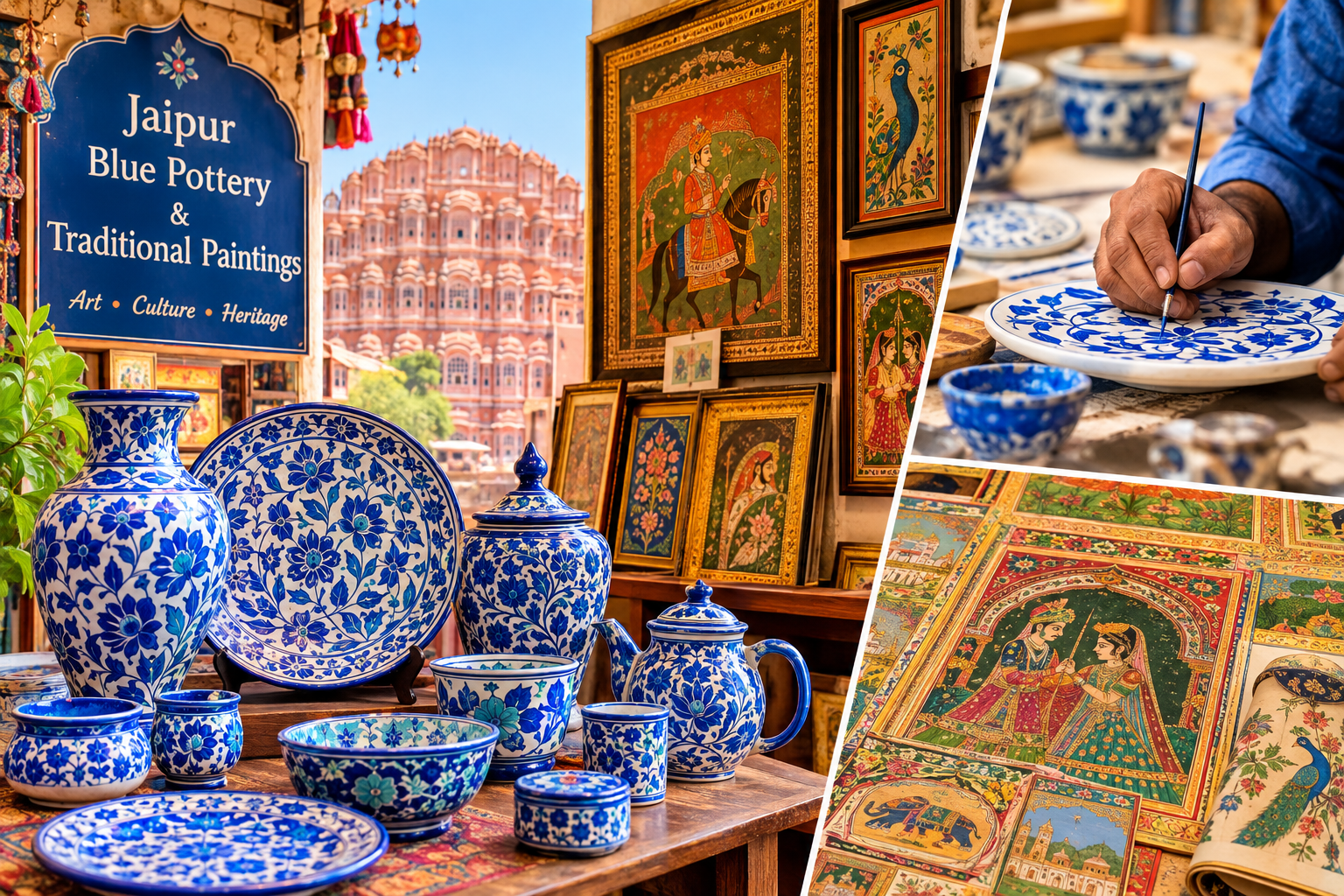
Jaipur, the Pink City of India, is famous for its magnificent forts, grand palaces, colorful bazaars, and royal heritage. But one of the most interesting ways to understand Jaipur is to explore its traditional arts and handicrafts. Two art forms that deserve special attention are Jaipur Blue Pottery and traditional Rajasthani paintings. Blue pottery is instantly recognizable for its brilliant blue, turquoise, and white patterns, while Rajasthani paintings are known for their detailed miniature artwork, royal scenes, religious subjects, colorful figures, animals, flowers, and scenes from everyday life. For tourists, visiting a blue pottery or painting shop is more than a shopping experience. It is an opportunity to see how Jaipur's artistic traditions have developed over generations and to take home a piece of Rajasthan's cultural heritage. In this guide, we explore the history of Jaipur Blue Pottery, traditional paintings, what to buy, where to shop, how these crafts are made, and useful shopping tips for Indian and international travelers.

What Is Jaipur Blue Pottery?
Jaipur Blue Pottery is one of Rajasthan's best-known traditional handicrafts.
Despite its name, traditional Jaipur Blue Pottery is not made from ordinary clay. The Rajasthan government's handicrafts information describes the material as a frit-based mixture involving ingredients such as quartz stone powder, powdered glass, Multani Mitti (Fuller's Earth), borax, gum, and water. The pieces are glazed and fired at relatively low temperatures.
The craft is famous for its distinctive decorative style, including:
- Cobalt blue patterns
- Turquoise and green details
- White backgrounds
- Floral motifs
- Birds and animals
- Geometric designs
- Mughal-inspired arabesque patterns
- Hand-painted decorative borders
The Rajasthan Tourism Department also identifies blue pottery as a traditional Jaipur craft and notes that its designs commonly include birds, animals, flowers, and other decorative motifs.
Why Is Jaipur Blue Pottery Called "Blue Pottery"?
The name comes from the characteristic blue color used extensively in the decoration.
Cobalt compounds are traditionally associated with the deep blue color, while copper-based colors can produce green and turquoise shades.
The combination of a light background with vivid blue decoration gives the craft its instantly recognizable appearance.
This distinctive color combination is one of the main reasons Jaipur Blue Pottery has become such a popular souvenir among visitors to Rajasthan.
History of Jaipur Blue Pottery
Blue pottery has a fascinating history that reflects the cultural connections between Central Asia, Persia, the Mughal world, and India.
The Rajasthan government's handicrafts information describes the technique as Turko-Persian in origin. Blue-glaze techniques traveled into India through historical cultural exchanges and eventually reached Jaipur.
There are different accounts of how the craft became established in Jaipur.
One historical account connects the arrival of the technique with the 17th century, while another emphasizes its development under Sawai Ram Singh II during the 19th century. The craft later declined significantly and was revived in Jaipur during the 20th century, with artist Kripal Singh Shekhawat playing an important role in its revival.
This long history explains why blue pottery is not simply a decorative souvenir—it is an important part of Jaipur's artistic identity.
What Makes Blue Pottery Different from Ordinary Pottery?
The biggest difference is the material.
Traditional pottery is generally associated with clay, whereas Jaipur Blue Pottery uses a quartz-based material.
The Rajasthan government describes traditional blue pottery as being made without conventional clay and notes that its low-temperature firing contributes to the delicate nature of many pieces.
This is also why travelers should handle blue pottery carefully when shopping.
A large vase or decorative plate may look sturdy, but it can be more fragile than an ordinary clay pot.
What Can You Buy in Jaipur Blue Pottery Shops?
Blue pottery shops offer much more than traditional pots.
Depending on the shop or workshop, tourists can find:
Blue Pottery Plates
Decorative plates are among the most recognizable Jaipur souvenirs.
They can feature floral patterns, birds, animals, geometric designs, or traditional decorative motifs.
Vases
Blue pottery vases are popular for home decoration and are available in different shapes and sizes.
Bowls and Trays
Small bowls and trays are practical souvenirs and are generally easier to carry than large pottery pieces.
Cups and Saucers
Some workshops produce tea sets, cups, and saucers decorated with traditional blue patterns.
Tiles
Decorative blue pottery tiles can be used as wall art or interior decoration.
Coasters
Small blue pottery coasters are useful gifts for friends and family because they are relatively compact.
Decorative Boxes
Small boxes and containers can be used for jewelry, keepsakes, or other household items.
Wall Plates
Decorative wall plates are another popular choice for travelers looking for something distinctly Rajasthani.
Jaipur Traditional Paintings
Blue pottery is only one part of Jaipur's artistic heritage.
The city is also associated with a variety of Rajasthani painting traditions, particularly miniature and decorative artwork.
Rajasthan's artistic heritage includes miniature paintings, murals, frescoes, and other forms of traditional painting.
When visiting painting shops and galleries in Jaipur, tourists may find artwork depicting:
- Maharajas and royal families
- Rajasthani women
- Krishna and Radha
- Hindu deities
- Palace scenes
- Hunting scenes
- Elephants and horses
- Peacocks and birds
- Flowers and gardens
- Musicians and dancers
- Village life
- Festivals
- Rajasthani landscapes
These paintings can range from traditional miniature-style works to contemporary artwork inspired by Rajasthan.
What Is Rajasthani Miniature Painting?
Rajasthani miniature painting is a detailed artistic tradition associated with the royal courts of Rajasthan.
The paintings are often characterized by:
- Fine lines
- Detailed figures
- Rich colors
- Decorative borders
- Elaborate costumes
- Palace and garden settings
- Religious and literary themes
For travelers interested in history and culture, miniature paintings can provide a visual introduction to Rajasthan's royal and artistic traditions.
When buying one, ask the seller whether it is an original hand-painted work, a reproduction, or a printed design.
The Connection Between Blue Pottery and Painting
At first glance, blue pottery and painting may seem like completely different art forms.
However, they have an important connection: both depend heavily on decorative painting and design.
A blue pottery plate may have an elaborate floral pattern painted by hand, while a traditional Rajasthani painting may contain dozens of carefully drawn figures and decorative details.
Both crafts also use recurring elements such as:
- Flowers
- Birds
- Peacocks
- Animals
- Decorative borders
- Geometric patterns
- Royal themes
- Nature-inspired designs
This makes it possible for travelers to explore both crafts as part of one Jaipur art-shopping experience.
How Is Jaipur Blue Pottery Made?
One of the most interesting things about buying blue pottery is understanding how it is produced.
Step 1: Preparing the Material
The traditional mixture is prepared using quartz and other ingredients rather than conventional pottery clay.
Step 2: Shaping the Object
The prepared material is shaped into the desired form.
This may be a plate, bowl, vase, tile, cup, or another decorative item.
Step 3: Drying
The shaped piece is allowed to dry before further decoration.
Step 4: Creating the Design
Artisans carefully apply decorative designs to the surface.
Traditional motifs may include flowers, birds, animals, and geometric patterns.
Step 5: Glazing
A glaze is applied to give the finished object its characteristic smooth and glossy appearance.
Step 6: Firing
The decorated item is fired at a relatively low temperature.
The result is a distinctive blue-and-white decorative object associated with Jaipur.
How Are Traditional Paintings Made?
Traditional paintings involve a very different process.
An artist begins by preparing the surface, which may be handmade paper, cloth, canvas, wood, or another material depending on the style.
The artist then creates the basic composition before adding increasingly detailed lines and colors.
In miniature-style paintings, extremely fine details may be added to clothing, faces, jewelry, architecture, animals, and decorative borders.
This detailed work is one reason traditional miniature paintings can take considerable time to complete.
Where to Shop for Blue Pottery in Jaipur
Jaipur has many handicraft stores, pottery workshops, and galleries.
Here are some places that can be useful starting points for tourists.
Jaipur Blue Pottery Art Centre
Located on Amer Road near Jain Mandir, this is one of the established blue pottery businesses visitors can explore.
Its location can be convenient for tourists combining handicraft shopping with sightseeing around the Amer Road and Amber Fort area.
Best for: Blue pottery shopping and understanding the craft tradition.
Kripal Kumbh blue pottery
Located in Bani Park, Kripal Kumbh is particularly interesting because of its connection with the modern revival of Jaipur Blue Pottery.
The Rajasthan government's account of the craft's history highlights the contribution of artist Kripal Singh Shekhawat to its revival.
Best for: Travelers interested in the history and artistic development of Jaipur Blue Pottery.
Jaipur blue pottery factory
Another blue pottery business is located on Amer Road near Ramgarh Moad.
Its location makes it possible to combine craft shopping with a Jaipur sightseeing route toward the Amer area.
Best for: Travelers looking for blue pottery and handicrafts along the Amer Road route.
Shiv Kripa Blue Art Pottery
Located in the Sanganer area of Jaipur, this is another option for visitors interested in blue pottery.
Sanganer is also associated with other traditional handicrafts, making it an interesting area for travelers who want to explore Jaipur's broader craft culture.
Where to Look for Paintings in Jaipur
For traditional and contemporary paintings, tourists can explore art galleries and painting stores in different parts of Jaipur.
One example is Mukesh Art Gallery ️ in Malviya Nagar.
Visitors can also explore Jitesh Arts in the old Jaipur area and Dholamaru Art Gallery near Amer Road.
For travelers staying in or visiting the Amer Road area, galleries and handicraft stores along the route can make it convenient to combine painting and pottery shopping.
Tip: Always ask whether a painting is hand-painted, printed, a reproduction, or an original work before purchasing.
Best Areas for Art and Handicraft Shopping in Jaipur
1. Amer Road
Amer Road is particularly convenient for tourists because it connects the city with the Amber Fort area.
Several pottery and handicraft businesses are located around this route.
You can combine:
Amber Fort → Amer Road handicraft shopping → Blue Pottery → City Palace
This makes a convenient cultural sightseeing day.
2. Bani Park
Bani Park has established businesses such as Kripal Kumbh and is worth considering for travelers specifically interested in blue pottery.
3. Sanganer
Sanganer is associated with several traditional craft industries and is another area to explore if you have extra time.
The Rajasthan government identifies Sanganer, along with Mahalan and Neota, as places where the blue pottery craft is practiced in addition to Jaipur.
4. Old Jaipur
The historic markets around the Pink City offer many opportunities to browse handicrafts, paintings, textiles, jewelry, and souvenirs.
How to Choose Good Blue Pottery
When buying blue pottery, take a few minutes to inspect the item carefully.
Check for cracks
Look carefully around the edges, base, and decorative surface.
Examine the painting
Look at the quality and consistency of the decorative work.
Check the glaze
A good piece should have an attractive finished surface without obvious damage.
Ask about handmade work
If you are specifically looking for artisan-made pottery, ask the seller how the piece was produced.
Check the purpose
Some pieces are primarily decorative, while others may be sold for practical use.
Ask the seller about appropriate care and usage.
How to Choose a Traditional Painting
Buying a painting requires a little more research.
Before purchasing, ask:
Is it hand-painted?
A printed image can look very similar to a painting from a distance.
What style is it?
Ask whether it is a miniature, folk-inspired, religious, contemporary, or another type of artwork.
Who painted it?
If the artist's identity is available, ask for details.
What materials were used?
Find out whether it is painted on paper, canvas, cloth, wood, or another material.
Is it an original?
This is particularly important if you are purchasing an expensive piece.
Blue Pottery or Painting: Which Souvenir Should You Buy?
Both make interesting Jaipur souvenirs, but they have different advantages.
| Blue Pottery | Traditional Painting |
|---|---|
| Three-dimensional craft | Flat artwork |
| Plates, vases, bowls and tiles | Miniatures, religious and decorative paintings |
| Distinctive blue and white appearance | Wide range of colors |
| Excellent for home decoration | Ideal for walls and framed displays |
| Fragile and needs careful packing | Paper/canvas works can be easier to transport |
| Strong association with Jaipur | Represents wider Rajasthani artistic traditions |
A traveler does not necessarily have to choose just one.
A small blue pottery piece combined with a traditional painting can create a meaningful collection of Jaipur souvenirs.
Tips for Foreign Tourists Buying Art in Jaipur
If you are visiting Jaipur from the United States, United Kingdom, Europe, Australia, or another country, keep a few practical points in mind.
1. Compare Several Shops
Don't purchase an expensive piece immediately after visiting the first store.
Look at several examples before making a decision.
2. Ask About Packaging
Blue pottery is delicate, so proper protective packaging is important.
3. Ask About Shipping
For large pottery pieces or paintings, ask whether the shop provides shipping.
Confirm:
- Shipping cost
- Delivery time
- Packaging
- Insurance
- Tracking
- Return or damage policy
4. Keep Your Receipt
Keep invoices and receipts for expensive purchases.
They may be useful for insurance, shipping, or customs documentation.
5. Check Airline Rules
If you are carrying pottery or artwork in your luggage, check your airline's baggage rules before traveling.
6. Check Destination-Country Customs Rules
International travelers should also check the import rules of their home country before purchasing valuable or unusual handicrafts.
How Much Time Should You Spend?
If you are simply looking for souvenirs, 30–60 minutes may be enough for a pottery shop.
Art lovers can easily spend several hours exploring different shops and galleries.
A dedicated Jaipur art-shopping experience could include:
Morning: Amber Fort
Late morning: Amer Road blue pottery shop
Afternoon: City Palace and Jantar Mantar
Late afternoon: Traditional painting gallery
Evening: Hawa Mahal and Jaipur market
This itinerary combines Jaipur's architecture, history, art, and shopping.
Jaipur Blue Pottery and Painting Shopping with a Private Car
For international tourists, exploring Jaipur's art shops with a private car and driver can be particularly convenient.
You can visit different parts of the city without having to carry fragile purchases while walking through crowded markets.
A typical private-car route could be:
Hotel → Amber Fort → Amer Road Blue Pottery Shop → City Palace → Hawa Mahal → Painting Gallery → Jaipur Market → Hotel
If you purchase large or fragile pieces, your driver can also help make the shopping experience more convenient by keeping the items safely in the vehicle while you continue sightseeing.
Best Time to Explore Jaipur's Art Shops
The cooler months from October to March are generally comfortable for exploring Jaipur's outdoor attractions and markets.
During the hotter months, indoor galleries and craft shops can provide a welcome break from the heat.
If you have a busy sightseeing schedule, consider visiting shops during the afternoon or late afternoon after exploring the major monuments.
Always check the latest opening hours of individual shops before visiting.
Why Buy Jaipur Blue Pottery and Paintings?
A souvenir becomes more meaningful when it represents the place you visited.
Jaipur Blue Pottery reflects a distinctive craft tradition shaped by Turko-Persian, Mughal, and Rajasthani influences. Traditional paintings offer another perspective on Rajasthan's royal history, religious traditions, nature, and everyday culture.
Instead of buying a generic souvenir, visitors can choose an object that connects them to the artistic heritage of Rajasthan.
A hand-decorated blue pottery plate on your wall or a traditional miniature-style painting in your home can serve as a lasting reminder of your Jaipur journey.
Suggested One-Day Jaipur Art and Heritage Route
If you want to combine sightseeing and shopping, consider this route:
Morning
Amber Fort
Spend the morning exploring one of Jaipur's most important historical attractions.
Late Morning
Amer Road Blue Pottery Shop
Explore blue pottery and learn about the craft.
Afternoon
City Palace + Jantar Mantar
Continue your Jaipur heritage sightseeing.
Late Afternoon
Traditional Painting Gallery
Spend time looking at Rajasthani paintings and miniature-style artwork.
Evening
Hawa Mahal + Jaipur Bazaar
Finish the day with photographs, shopping, and local food.
This route allows you to experience Jaipur's history, architecture, handicrafts, painting, and shopping in a single day.
Frequently Asked Questions
Is Jaipur famous for blue pottery?
Yes. Blue pottery is one of Jaipur's best-known traditional crafts and is widely recognized as part of the city's handicraft heritage.
Is Jaipur Blue Pottery made from clay?
Traditional Jaipur Blue Pottery is not made from conventional clay. It uses a quartz-based frit mixture with ingredients such as powdered glass, Multani Mitti, and other materials.
What should I buy from a Jaipur Blue Pottery shop?
Popular choices include decorative plates, vases, bowls, cups, trays, tiles, coasters, boxes, and other decorative objects.
Can I buy traditional paintings in Jaipur?
Yes. Jaipur has art galleries, painting stores, and handicraft shops where visitors can find traditional and contemporary Rajasthani-inspired artwork.
Is blue pottery fragile?
Traditional blue pottery can be relatively fragile because it is fired at a low temperature. Ask the shop to package your purchase carefully, particularly if you are flying home.
Can I ship blue pottery internationally?
Some businesses may offer shipping, but services vary. Ask the individual shop about current international shipping, packaging, insurance, and delivery arrangements.
Final Thoughts
Jaipur's artistic identity extends far beyond its famous forts and palaces.
Blue Pottery and traditional Rajasthani paintings provide travelers with an opportunity to discover the creative traditions that have helped define Rajasthan for generations.
Blue pottery stands out for its distinctive blue-and-white designs, unusual quartz-based material, glossy finish, and decorative motifs. Traditional paintings provide a colorful window into Rajasthan's royal, religious, and cultural heritage.
For tourists, exploring both crafts is an excellent way to turn ordinary souvenir shopping into a cultural experience.
So, during your next visit to the Pink City, leave some space in your itinerary—and your suitcase—for Jaipur's blue pottery, miniature paintings, and other traditional works of art.
A beautiful piece of Jaipur art is not just a souvenir; it can be a lasting reminder of the colors, craftsmanship, history, and culture you experienced in Rajasthan.